Field of Science

Approvals are always nice =D

YAY! Application to coordinate a student directed seminar on 'evolutionary theory in the humanities' got approved! (plan is: 1/3 biological evolution (emphasis on molecular and microbial stuff that usually gets thoroughly ignored), 1/3 evolutionary linguistics, 1/3 critical analysis of memetics and applying prev two sections to other humanities fields; entire thing is participant-led, so no teaching; anxiously anticipating what happens to the final project, which will be literature-research based)

As excited as I am right now, there is A LOT, A freaking LOT of work to do now. This is going to be a nightmare, especially since we're trying to span two faculties and countless departments therein. But it's exciting! So lucky our university has this opportunity...

Anyway, still got a few hours of microscopy aherad of me... waaah!

Oh, and ha!: "Memetics is dead" my sorry ass! =P

I plan to post more details later, but any suggestions/criticisms/discussions are welcome and encouraged! If you know of any potentially useful sources/references, please let me know too!

Back to lab slaving... can't wait to finish so I can go home and devour my protist porn Research in Protozoology volumes...

PCR Flu

After a week of my PCR failure, I finally got it to work. However, a masters student now can't get his alive in any way, which prompts one to contemplate the possible existence of some infectious PCR disease, a flu if you will, that spreads around labspace plaguing one unfortunate victim after another.

A new journal title is in order: J. PCR Flu Epidemiology. I think I finally found a place to publish my gels!

Said journal should also feature PCR horoscopes:

eg.
Aquarius: The -something- is in the way of the path of -some star- (I don't really read these, can you tell? o_O) Check your dNTPs. Your entire stock may have gone bad.

Pisces: While at first you may feel confident following a long line of successful gels, you should be extremely cautious in a couple of weeks - treat your Taq with care and be sure to put all the reagents back in the -20.

Cancer: You're fucked. Seriously, go wash some glassware and clean the lab windows instead for the next few weeks... nothing you do will save your product from instant degradation by the wrath of the PCR gods.
Etc.
Anyway, I have a long night of microscopy ahead of me... good bye life, it was nice having you!

PS: I got catnip: 3 volumes of 1969 Research in Protozoology (ed.: Chen) from a nice ciliatologist. It's simply incredible. I'm dehydrated from drooling over it so much. Protistologists are very evil people. Worse than drug dealers... =P

Sunday Protist - Ebria

ResearchBlogging.orgSomeone here wanted Ebriids and Ellobiopsids. Since I'm still in a bit of Rhizarian mood, let's do Ebriids first. Just as you thought we couldn't get any more obscure than Phaeodaria...

Ebriids are biflagellate Cercozoans (see the Pawlowski & Burki 2009 Rhizaria tree in the Coelodiceras post for their phylogenetic neighbourhood) with a characteristic silica endoskeleton, permanently condensed nuclear chromatin and lack of cell wall or scales. They are rare and still unculturable, so very little is known about them. The taxon name derives from ebrius ('drunken' lat.) as they apparently swim in a strange fashion. (Hoppenrath & Leander 2006 Protist)

They feed on diatoms and dinos, likely using pseudopodia in their feeding (an interesting feature of Cercozoans is their affinity for pseudopodia despite being flagellate...) Interestingly, they too, like some dinos, can devour diatom chains in a process that seems similar to palium feeding. Due to their silicoflagelate nature, they have been caught up in the taxonomic chaos and have been considered to be dinos or radiolarians; they were thrown around between the two for decades, until the eerie Enlightenment through molecular biology placed them in Cercozoa. (all from Hoppenrath & Leander 2006)

(Hoppenrath & Leander 2006; arrow in A points to nucleus; scalebar: 10μm)

The silica endoskeleton leaves behind a nice fossil record stretching back to the Cretaceous, although very few modern species have been found (Hargraves 2002 Plankton Biol).

(Korhola & Grönlund 1999 J Paleolimnol. Silica Ebriid skeletons from Baltic sediment)

I wonder if their genomes too conceal some quirky stuff. Permanently condensed chromosomes tend to do that (see dinos; Euglenids have them too but nothing seems to be known about their genomes yet).

A bit tired and sleepy... apologies for low energy post today.
---
As for "just why is everything about dinoflagellates just so *%&$ing weird?"* - Simple. On the 7th day of creation, the intelligent designer took a break, got really high off some awesome shit he'd just finished creating, and made the protists. Dinos were created near the climax of his hallucinations, while ciliates were definitely made right AT the climax. Thus, ciliates are the Higher Eukaryotes, with dinos and the rest of Protista close behind. Now for a reading from the Book of Tom... oh, has anyone tried that while 'under influence'? Does it help?

*In case some are as clueless about dinos as I was less than a year ago, the following is some of the oddities:
Nucleus
- permanently condensed chromatin
- massive genomes (>10x that of humans)
- chromosome structure on crack
- mandatory trans-splicing of 5'-cap-bearing splice leaders onto mRNA transcripts. Ie each mRNA transcript must have another specific mRNA sequence attached to its beginning, otherwise it gets degraded. Interestingly, Trypanosomes and some genome in C.elegans do that too, and have polycistronic genes, which is highly unusual for eukaryotes. Ie. several genes following one promotor... more on that later sometime!

Mitochondria
- tiny genomes
- rRNA assembled from fragments, some of which are imported from the nucleus
- some species: single gene linear chromosomes; some have long scrambled repeating permutations of three conserved mitochondrial genes (COX1,3; COB)
- post-transcriptional RNA editing; ie a transcript is made, and then some bases are modified prior to translation
- trans-splicing (of exons located on different loci) (usually splicing happens in cis, by remvoing a region between two exons; trans-splicing involves taking two exons from different regions and gluing them together.

Plastids
- single-gene minicircles - genome consists of tiny circles usually containing a single gene and a replication origin sequence.

Misc
- closed mitosis (Nu envelope doesn't break apart; although not that unusual)
- prone to tertiary endosymbiosis (eg. Karlodinium, Karenia, Kryptoperidinium, Lepidodinium, Dinophysis)
- diversity of lifestyles, from endo- and ectoparasitism and endosymbiosis to myzocytosis (sucking prey through a 'straw') to palium-feeding; all while roughly half of them are photosynthetic
- Warnowiid dinos with... camera eyes!

Since it's kinda late and I'm sleepy and don't have time to reference all that... let's just pretend this footnote never happened, k? ^_~ I should blog about this properly later...

---
Hoppenrath, M., & Leander, B. (2006). Ebriid Phylogeny and the Expansion of the Cercozoa Protist, 157 (3), 279-290 DOI: 10.1016/j.protis.2006.03.002

Hargraves, P.E. (2002). The ebridian flagellates Ebria and Hermesinum Plankton Biology and Ecology, 49 (1), 9-16

Korhola, A., & Grönlund, T. (1999). Observations of Ebria tripartita (Schumann) Lemmermann in Baltic sediments Journal of Paleolimnology, 21 (1), 1-8 DOI: 10.1023/A:1008019504122

"Two things are infinite..."

I generally refrain from bashing creotards here as it's done much better in other blogs, but the sheer authentic pure idiocy here is simply astounding. I mean, just, wow.

So naïve. Dawkins, I mean. Does he seriously think it's possible to have a rational reasonable any conversation that...[censored]...silly person?

Added to the So Stupid One Cannot Come up with Valid Counter-arguments list.


PS: Vote against the cheese! --->

(The cheese option comes from a joke on a forum, where they refuse to vote in a poll devoid of cheese option. However, they weren't supposed to pick the cheese option itself, those cheeky bastards! Hey, to all you voting cheese: Don't make me go into the biochemistry or microbiology thereof; it doesn't mean you'd just get away with appetising pretty pictures!)

Help me pick the next topic!

Since I'm a disorganised indecisive scatterbrain, how about you help me pick the next topic? Otherwise I start writing 10 posts in parallel and never finish any... (my drafts folder is massive...) I've set up a poll to the right --->

Also, additional suggestions definitely welcome and encouraged! As are random questions/comments/musings/criticisms/rants/etc. You guys need to comment more proliferously. Especially those whose blogs I plague with mine ^.^

Blue isopod time:

Found it in California, never seen a bluish-purple one before. I wonder if it's an allelic thing, or actually a separate species altogether...

Sunday Protist - Obscure Phaeodarian: Coelodiceras

ResearchBlogging.orgChoreocolax and Ecomonymopha not obscure enough? Let's go for Phaeodaria then! I've been neglecting Rhizarians, just like everyone else. When I first saw a eukaryotic tree, I could recognise a thing or two in most of the 'kingdoms'. Except one: Rhizaria. All those names were absolutely meaningless to me. Those wonderful earthly aliens desperately need an introduction to the world beyond dusty 1970's oceonography journals!

Rhizarian taxonomy (nitpicky details alert)
Rhizaria is a very morphologically diverse group held together mainly by molecular data. It has everything from amoeboid Chlorarachniophytes, 'famous' for secondary endosymbiosis of a green algal plastid; seashell-like Foraminifera; flagellates like Heteromita, scaly-tested Euglyphids; to spiny Radiolaria, so wondefully illustrated in Haeckel's Kunstformen der Natur (pdf of original available on that page). It's a tremendously understudied group...

So where do Rhizaria fit in the tree of life? From the same year: Moreira et al. 2007 Mol Phylogenet & Evol: basal to Chromalveolates and Archaeplastids; Hackett et al. 2007 Mol Biol & Evol: basal to stramenopiles+alveolates. Shit. Conundrum. Knowing nothing about trees, I could resort to Proof by Impact Factor:
MPE: 3.871
MBE: 7.280
Branching with stramenopiles+alveolates it is. QED.
Alternatively, we could check later sources: Baldauf 2008 J Systemat & Evol and Keeling 2009 J Euk Microbiol place the Rhizarians basal to stramenopiles+alveolates, although not fully certain, whereas TC-S (sen. author of Moreira et al. paper) insists on sticking it basal to chromalv+archaeplastids in his latest megaphylogenetic megatree of megaeukaryotic megaevolution (TC-S 2009 J Euk Microbiol). Time for Proof by Democracy...

And suddenly I realise probably no one here (except the taxonomist =P) really cares where Rhizaria roots, so let's move on.

Another taxonomic troublespot is Radiolaria. Originally they included Acantharia, Spumellaria, Nasselaria and Phaeodaria, but it turns out Acantharians are quite unique due to their strontium(!) sulfate skeletons (as oposed to silica in Nasselaria and Spumellaria), while Phaeodarians are a whole other thing altogether, quite distant from the rest of the 'radiolaria'. Nowadays, Nasselaria and Spumellaria are clumped into Polycystea, with Acantharians forming their sister clade. Like this:

(Pawlowki & Burki 2009 J Euk Microbiol)
(Phaeodaria are in Cercozoa)

Ah, so many more new obscure organisms to read about! *drools*

Coelodiceras spinosum
Now for some Coelodiceras spinosum from Paterson et al. 2007 Deep Sea Research Part II: Topical Studies in Oceanography:
(Scalebar: 200μm)
Phaeodarians are unicellular organisms composed of a fine cytoplasmic mesh surrounding a delicate silica skeleton. They contain a central capsule with a large opening leading to a phaeodium, a congregation of food and waste vacuoles. They are fierce predators devouring anything from bacteria to dinoflagellates and diatoms by catching them with rhizopodia, or fine thread-like extensions of the cytoplasm. Some have a single large polyploid nucleus (Dogiel' 1965 General Protozoology). Would be pretty interesting if this one also has only a single large nucleus, since cells this big tend to be multinucleate.

The most is known about their skeletal structure, since that is what is easiest to preserve and deal with. They fossilise well, and are used as indicators in the oil industry. Sadly, almost nothing is known about the genetics and developmental biology of these organisms. Many of them inhabit the deep sea (eg. Coelogiceras), and are difficult or simply impossible to culture. As a rule of thumb, predators are complicated to deal with, especially if their lifestyle is unknown - sometimes they may require auxiliary organisms to be present to process their prey in such a way that they can make use of it, for example. It's a pain.

Some more details of the skeleton: (again, from Paterson et al. 2007)


It would be fascinating to know the function and development of these intricate structures, but the paper is mostly descriptive (the specimen was already dead before collection), and finding further information on their cell structure is incredibly difficult. This is probably the most difficult post I've yet written, with about two hours of literature research going into each paragraph on average. But I hope this inspired some appreciation of how complex a unicellular organism can get!

References
Dogiel, V. A., (1965) General Protozoology. Revised by J. L. Poljanskij and E. M. Chejsin (II. Auflage) VII und 747 S., 326 Abb. Oxford: Clarendon Press

Hackett, J., Yoon, H., Li, S., Reyes-Prieto, A., Rummele, S., & Bhattacharya, D. (2007). Phylogenomic Analysis Supports the Monophyly of Cryptophytes and Haptophytes and the Association of Rhizaria with Chromalveolates Molecular Biology and Evolution, 24 (8), 1702-1713 DOI: 10.1093/molbev/msm089

KEELING, P. (2009). Chromalveolates and the Evolution of Plastids by Secondary Endosymbiosis Journal of Eukaryotic Microbiology, 56 (1), 1-8 DOI: 10.1111/j.1550-7408.2008.00371.x

Moreira, D., von der Heyden, S., Bass, D., López-García, P., Chao, E., & Cavalier-Smith, T. (2007). Global eukaryote phylogeny: Combined small- and large-subunit ribosomal DNA trees support monophyly of Rhizaria, Retaria and Excavata Molecular Phylogenetics and Evolution, 44 (1), 255-266 DOI: 10.1016/j.ympev.2006.11.001

PATERSON, H., PESANT, S., CLODE, P., KNOTT, B., & WAITE, A. (2007). Systematics of a rare radiolarian—Coelodiceras spinosum Haecker (Sarcodina: Actinopoda: Phaeodaria: Coelodendridae) Deep Sea Research Part II: Topical Studies in Oceanography, 54 (8-10), 1094-1102 DOI: 10.1016/j.dsr2.2006.05.046

PAWLOWSKI, J., & BURKI, F. (2009). Untangling the Phylogeny of Amoeboid Protists Journal of Eukaryotic Microbiology, 56 (1), 16-25 DOI: 10.1111/j.1550-7408.2008.00379.x

The story of Psi, and why I blog under a pseudonym

Some people may be wondering why the hell I'm posting under a pseudonym; and why, of all things, 'Psi Wavefunction'?

First off, a brief story of Psi:
'twas the night before my first physics final, while I was still innocent and optimistic about the whole exam concept. I was so sure I was gonna totally pwn all my finals, since ass-kicking in highschool apparently implied intelligence or something, at the time. Pwnage did happen, but not in the expected direction. But I digress. I was stupid enough to sign up for a hard-core first year integrated sciences program, and thus our physics curriculum was on steroids. And crack. Also, said program was called 'Science One', and the symbol devised by prior students was an uppercase Ψ with the middle stroke being shaped like a 1. Quite fun to write.

We were playing around with Schroedinger's equations, with something about a wavefunction being like Ψ(x) = scary stuff I forgot by now. That was also a lot of fun to write. My friend down the hall was a comic artist, so I was kind of envious of the massive perpetual party hosted inside her head. So with exam stress building up, somehow a pair of eyes happened atop Ψ(x), and thus Psi Wavefunction, the Son of Schrö, was born.
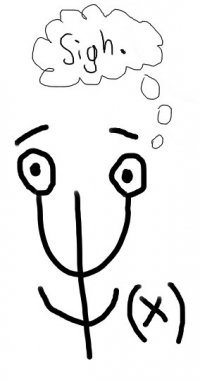
I think he looks kinda cute. And yes, Psi thinks 'Sigh'. haha. Later, Partial, hNu, Neuron et al. came along, and I even had a few comic strips involving them, but sadly never got around to making any storyline with them, which would have been fun. Still, he got to live on as my internet alias. There is the inconvenience of being contacted by physicists thinking I'm one of their ilk, only to find out I fled from PHYS101 with flailing arms after the second time...

The most abstract (and therefore, cute-prone) geeky characters tend to come from physics and math, where the whole subject is fairly abstract. Biology is much harder to cutify, especially since adding humanoid eyes to other animals and beyond would be kinda weird. I do have some viruses surfing on E.coli somewhere though... (before I started doodling protists on my notes, it was cartoonified molecules and cells...)

Our prof mentioned that exonucleases were 'like pacman', and this is the horrible, horrible result.

I have no idea why 'Euglena has 4 chloroplasts' was mentioned, but that doesn't sound right at all... I can't find anything about 'four chloroplasts' in Euglena, and a quick image search reveals the statement to be rather questionable. This is what happens when a zoologist starts talking about protists... can you imagine making a statement like "Fish have 5 fins" and getting away with it? But making a similar statement about a 'lower eukaryote' is perfectly acceptable... but I digress again:

Since we're on the topic of classroom doodling, obligatory protist doodles:

Fun times... anyway, how did we get distracted from Psi?

Next topic: Why blog under a pseudonym?
Some people assume that writing under anonymity or a pseudonym is for propagating potentially offensive or insulting views while being safe from the repercussions. Sure, some people do take advantage of internet anonymity to act like total assholes without any consequences. And that's what free speech is all about anyway: it protects erudite ideas as well as vulgar obscenities and utterly moronic statements. The same goes for acting under an alias: sometimes it gets abused for flaming and spamming, sometimes it can be perfectly benign or even beneficial.

However, that's not really the reason I do it. I'm probably more upfront and aggressive in person, especially to those I know. Here I target my posts at strangers, so a fair bit of politeness comes out naturally. I generally refrain from referring to sub-par ideas here as 'totally fucking moronic', as it's not a particularly constructive form of discourse. In real life, however, it can be a perfectly acceptable and satisfying way to share your disagreements in certain circumstances, eg. with your friends.

One of the main reasons I use a pseudonym is in case a putative future employer accidentally chances upon this, and gets to know my blog before getting to know me in person. I'd like to be in modest control over how someone gets a first impression of myself, especially where it matters. While I don't write anything here I wouldn't say in real life, some of the stuff I wouldn't say in an interview. It feels like a blog post rids you of the ability to choose who gets to see it and in what context.

Also, since I don't currently work in the field of protistology, it feels awkward to write about it, especially with true experts on the prowl (literally, as I found out yesterday... hi there!). An undergrad isn't really supposed to keep a science blog, so I try to diffuse that little detail with an alias. That said, don't adjust standards accordingly: please let me know of any inaccuracies or outright bullshit!

Lastly, I'm trying to keep my department affiliations kind of hidden (and really failing at it...), just in case. I woudln't want to unintentionally embarass them by writing something stupid here, so it's best if the readership is for the most part unaware of who'd be insane enough to employ this freak =P


And one last note... in case it looks weird that I don't blog about my own research: I do find it fascinating and am dying to write about it, but the Arabidopsis field is quite competitive so it's best to keep scoopable material hidden until publication. I could write about some published works, but most of the stuff I read relates directly to our current work, and might give some ideas/clues to certain labs that have screwed us in the past. Not that there's any real probability of them showing up here of all places, but if it were to only happen once my boss (and labmates) would probably rip my head off and autoclave it. (Would that be Risk Group III?)

That said, I have gels to run and drugs to do... on my plants. Toodles~

Melting in Vancouver...

It is almost midnight and 27 fucking degrees outside, and humid as hell. No fucking way can I write anything marginally intelligent right now, while melting away into a sticky puddle of sweat and anguish. Typing has become a strenuous physical exercise, each keystroke trickling on into a raging torrent of perspiration. This is not supposed to fucking happen in Vancouver! I've spent six long summers in Toronto, and was so glad to have fled the awful, horrible climatic hell that is the Great Lakes summer (not the winter, mind you - I actually enjoyed those! A bit of bone-chilling frost is good for you =P).

And apparently, today was the hottest day in Vancouver/Lower Mainland in recorded history... just 6 months ago, we had one of the coldest, snowiest winters ever. At which time Toronto had +17 in early January. And now, TO is at a tolerable 18C. I think we somehow swapped weather...

I hate heat. I hate it so much it was one of the major factors that forced me out of the east. No point in living in a place where you can't function for 6 months of the year... winters are ok, just wear more clothes and it's quite nice and refreshing even. But the fucking 38 degree summers with humidex way well in the 50's is simply insane.

Which brings me to wonder... why is it that we African primates suck at tolerating heat so much? It's not like people living in the tropical regions fare much better than us; they're just more accustomed to the discomfort, but there doesn't seem to be much fundamental difference physiologically. They too must avoid excess sun and stay somewhere cool and drink lots of water; danger of heat stroke is very real to them as well. So how is it that we are so poorly adapted to what is supposed to be similar to our more-or-less native climate? 40 000 years shouldn't be that much time for substantial change! And even if we did lose the tolerance somehow upon migrating north, that still doesn't explain the aforementioned low physiological differences.

Intelligent design my sorry ass - how incompetent must a designer be to create his chosen species to be poorly adapted to survival on the vast majority of the earth's surface?

This goes for 'evolutionary creationism' (directionalistic hyper-adaptationism) too - perhaps we never have really adapted to live comfortably in the heat, but the discomfort (and the occasional heat stroke) wasn't enough to stop our lineage from continuing. Perhaps our ancestors once originated elsewhere, or, more likely, were better adapted and some later developments/adaptations in our lineage enabled us to lose those features. Eg. no need to devote energy to growing fur if you can obtain it from another animal (NOT saying this is what actually happened! Not particularly familiar with anthropaleontology anyway...)

Anyway, let's see if I can melt into sleep... somehow I doubt it. =(

Sunday Protist - Dinophysis: Whirling teapots...

Since I'm busy with Student Directed Seminar proposal revisions that's due tomorrow (which I naturally left until tonight) this will be more of a 'protist appreciation' post rather than anything educational.

Here's some Dinophysis, a group of dinos with rather interesting morphologies. (though the top left and the very bottom left aren't part of this group, as far as I know) I've first come across these in Haeckel's drawings, and thought he was making this stuff up. Apparently, there really are organisms vaguely shaped like whirling teapots:

(Source: Waller Lab); main page here (with more pretty pictures)

Also, these have undergone a tertiary endosymbiosis event with a cryptomonad. As cool as they are, they're fairly understudied as some have only been cultured fairly recently. Even more interesting morphogenesis questions there...

---
And shit, someone just timetravelled forwards and 'scooped' my ideas. People (zoologists+botanists) usually give me funny looks when I say cell differentiation in multicellular organisms is but a spatial version of developmental stage differentiation in unicellular ones... but I'm not alone! =D

Must be a Russian thing. Привет, братья! ^_^

Sunday Protist - Dinoflagellate eats Chaetoceros (gory) (for real this time!)

ResearchBlogging.org(Yesterday's attempts were derailed by having to shred some New Age BS instead)

The media seems to be obsessed with posting pictures/videos of things eating things; apparently that generates a lot of revenue interest. Since I'm neck deep in syntactic trees and X-bar theory (Yes, I voluntarily, by my own will, as an elective, take third year syntax & grammar courses. Also, I dislike Chomsky. Clearly, I am very sane), I'm going to resort to posting gory pictures: (and yes, I mixed up Chaetoceros with Skeletonema in the previous post. Sue me. =P Not that I pursued the topic any further over there)

Following images from Jacobson & Anderson 1986 J. Phycol, unless otherwise stated)

A dino (Protoperidinium) extends its pallium (feeding pseudopod) to devour a sizeable chain of diatoms (Chaetoceros); why bother bringing food to your mouth/gut when you can bring your gut to your food instead?

Yes, it eats that whole thing! Super Big Macs and 12" subs would be no problem for Protoperidinium, although this fine diner probably actually has standards.

More gore:

So cute, yet so voracious! NOM NOM NOM /memeplex

Detail of feeding apparatus:

(Jacobson & Anderson 1992, J Phycol)
The pallium can be described as a 'feeding' veil, a feature found in some thecate (armoured) predatory dinos, which cannot devour large prey as their expansion is limited by the thecal plates (an alternative is myzocytosis, or 'drinking through a straw'). The dino then proceeds to digest its prey much like a fungus - by secreting digestive enzymes and consuming the useful products (from ToLweb Dino page).

Diversity of dining etiquette among knightly armoured dinoflagellates:


Dinoflagellate feeding is a fascinating topic in itself, but I should probably abstain until after the upcoming final. Added to post topic queue.

I honestly intended for this post to consist of one picture; then I got carried away. Scholarly literature is addicting (that's normal, right? *crickets*)

/massive procrastination foray

Jacobson, D., & Anderson, D. (1986). THECATE HETEROPHIC DINOFLAGELLATES: FEEDING BEHAVIOR AND MECHANISMS Journal of Phycology, 22 (3), 249-258 DOI: 10.1111/j.1529-8817.1986.tb00021.x

Jacobson, D., & Anderson, D. (1992). ULTRASTRUCTURE OF THE FEEDING APPARATUS AND MYONEMAL SYSTEM OF THE HETEROTROPHIC DINOFLAGELLATE PROTOPERIDINIUM SPINULOSUM1 Journal of Phycology, 28 (1), 69-82 DOI: 10.1111/j.0022-3646.1992.00069.x

Also see: Gaines & Taylor 1984 J Plankton Research "Extracellular Digestion in Marine Dinoflagellates"