Field of Science

I hate Macs.

So. Much.

Please, are there any sane people left out there? Am I really alone? Is anyone else sick of getting owned by a stupid white/light grey box every 5 min because some morons are obsessed with making their products 'sleek' rather than something that actually works in a sensible way, and is compatible outside the small special cult they formed???

The only reason Macs are 'safer' in terms of viruses is because Apple has such a small percentage of the total market share that one would have to be a total idiot to write viruses for them. Although considering the arrogance of many Mac fanatics (bordering on religious fervor), it is somedays really fucking tempting to write one.

Can't wait to save up enough to finally get my own computer again. It will definitely be a PC. And all you mac users will save your files in sane formats to accomodate the other 99% of computer users. We are not inferior to you.

Maybe I should just go ahead and install GNU/Linux everywhere in the lab. MWAHAHA. Too bad I probably don't have sufficient computer skills to do so =(

Ok I think I can proceed with my work now. Writing this from a Mac right now... how does one autoclave a blog? Ewww the cooties...

Pwned by Euglena* earlier and now by a Mac. My day really sucks...

*I think I just discovered the first strain of those fuckers who are NEGATIVELY phototactic. That's right, they consistently move AWAY from the light, or ignore it altogether at lower intensities. Photosynthetic organisms displaying photophobia. Oh yeah, makes so much sense. Maybe tomorrow the laws of nature will hate me a little less...

Do giant deep sea isopods have protist endosymbionts?

Apparently not as of this [admittedly slim] description of intestinal microbes from 1982. Seems to be mostly bacteria and nematodes - though one wonders if there are some cool gregarine or something inside one of those.

On the topic of isopod gut endosymbionts (though not of the deep sea), there's a recent PNAS paper starring a wood-boring isopod devoid of cellulose-digesting gut microbes, capable of lignocellulose digestion all on its own! (King et al. 2010 PNAS "Molecular insight into lignocellulose digestion by a marine isopod in the absence of gut microbes") Limnoria quadripunctata, quite amazingly, actually lacks gut microbiota entirely (unlike the bivalve woodboring 'shipworms', which do have a flourishing gut culture) and as animals are known for failing at lignocellulose digestion on their own, raised some interesting questions about how they do it.

Turns out, Limnoria not only has unusually high glycosyl hydrolase (GH) expression levels in its transcriptome, but also the first described case of endogenously produced GH7 in metazoa. This was then followed up by finding GH7 expression in the Daphnia and Gammarus(both also crustacea) ESTs. Seems like the GH7 domain is key to self-sufficient cellulose digestion, in animals anyway. Another question is...how did it get there? LGT from somewhere? The authors consider recent LGT unlikely as the metazoan sequences are quite distant from anything else in tree (and don't fall in the midst of another clade; though there's arguably too few sequences to judge at this point).

Thus, it seems that what most strikingly enables the gastromicrobially deprived Limnoria to digest wood on their own is GH7 (and potentially hemocyanins). Curiously, the most abundant cellulases in the termite gut, produced mostly by its protist symbionts, are GH7.

This little adventure, like most others on this blog, was completely unplanned and sporadic. Someone brought up deep sea isopods, thus I couldn't just ignore that very important question of ultra high priority. Mostly because giant isopods are fucking cool. Oh, and giant. Would make an adorable, wonderful pet, if it weren't for the whole deep sea thing.

Source: Ross Gwynn on Reddit. 2.5 feet long, or roughly 75cm, though that may be exaggerated.

Sunday Protist -- Tachyblaston: A suctorian parasite of suctorians

ResearchBlogging.org[it's totally still Sunday in someone's mind somewhere...right?]

Reading old protistology books can be quite a frustrating exercise: image you come across a really cool-looking organism, try to follow up on what happened to it since, and discover it's only been written up once in the distant past and neglected ever since. This happens to a very annoying percentage of organisms described in those older books (newer books tend to forget the phantom and near-phantom species). Now this organism in particular at least has a very detailed source behind it, but alas! ...in German. I saw it in Grell's (1973) Protozoology, and the original description comes from... Grell 1950 . The former I have an English copy of, the latter I do not. So don't expect much detail.

Ecologists often lump microorganisms together as 'decomposers' (at least in undergrad courses); those of us living in a different scale of things beg to differ. From an intro ecology text, you get the idea that ecology somehow ceases to happen once you reach a certain size or phylum, and everything's just a part of this amorphous blob that exists to recycle nutrients so that the rest of us can live on. Shockingly enough, this amorphous blob has a whole ecosystem of its own, complete with predators and photosynthesisers and those who do both, as well as parasites and mutualist endosymbionts and saprophytes, etc. They interact with each other in ways not in the slightest less interesting than fluffy animals. In the microscopic world, cells become bodies that, just like ours, can get hunted, infected or benefited by some other organism. Or host a pile of commensals (who do exist, by the way, by similar arguments that Nearly Neutral Theory employs for mutations)

*Zoological ecologists also tend to treat plants as 'those things that exist for animals to eat', which annoys the hell out of anyone dealing with plants. On the first day of ecology the instructor causally mentioned that 'plants don't do much in the way of behaviour', and thus the course will largely ignore them. I expressed disagreement after class, noting there is little fundamentally different between a plant biochemical response leading to, say, discharge of toxins or some regulatory change, and an animal biochemical response leading to observable [to our eye] mechanical change. Yeah, this is why I have difficulty talking to the more 'traditional' biologists sometimes...but that is completely off-topic.

Remember how crabs can sometimes be covered in sea anemonies? Many smaller crustaceans can often be covered in organisms superficially resembling miniature sea anemonies - namely, Suctorians - highly derived (=weird) ciliates covered in miniature tentacles. Suctorians also reproduce by budding, as opposed to conventional symmetrical mitosis employed by the canonical ciliate. Just like sea anemonies and other cnidarians, suctorians also have stalked and swarming forms, like the polyp vs. medusa destinction in the former. Which is quite unsurprising, really, as aquatic sessile organisms usually use specialised free-swimming forms to spread. But still another cool bit of ultimate convergence discussed a couple posts ago.

Top: A copepod covered in suctorians; an SEM of Ephelota gemmipara from the copepod. (Fernandez-Leborans et al. 2005 J Nat Hist) Bottom: Ephelota superba, suctorian episymbiont of Antarctic krill. Quite reminiscent of an anthozoan. (Stankovic et al. 2002 Polar Biol)

Now, imagine a microscopic sea anemone being parasitised by another. I'm not sure whether there are any cnidarian parasites of other cnidarians (wouldn't be too surprised), so the analogy stops around here. The awesome does not, however: parasites are never truly simple. Tachyblaston's infancy consists of finding an Ephelota, attaching itself and piercing the cell membrane to leech off the cytoplasm. Over time, the entire cell can become filled with parasites. During this stage, the parasite buds to produce swarmers.

Tachyblaston invading Ephelota cell body. Right: Tachyblaston budding. (Grell 1950 Z.Protistenk)

Afterwards, the swarmers swim around and attach themselves to an Ephelota stalk, where they themselves form a stalked cup structure. There the parasite buds multiple times, yielding a cup full of Tachyblaston, which is subsequently emptied as the buds (this time with a single thick tentacle, according to Martin 1909) evacuate and crawl up the stalk toward the main cell body of Ephelota to infect it and start the cycle over.
Left: Swarmers. The stage that actually sort of looks like a ciliate... Middle: Full 'cup' of Tachyblaston in stalked stage. Right: Empty cup after all (Grell 1950 Z.Protistenk)

To summarise Tachyblaston's life cycle, the cell-penetrating parasites of the Ephelota cell body bud to form swarmers, which, in addition to reminding us of suctorians' ciliate leanings, find another Ephelota and attach themselves to the stalk, forming a cup which they fill up by budding again, finally releasing single-tentacled forms that crawl up the stalk to the next victim. How's that for unicellular organisms having 'primitive' differentiation capabilities?

Overview of the whole life cycle of Tachyblaston. Oh the tentacles... (Grell 1950 Z.Protistenk)

Tachyblaston's original description by Martin 1909:380 J Cell Sci can be found here. The parasite was very distinctive due to a major refringent particle of unknown origin or function present within each Tachyblaston cell. The genus name reflects the extraordinary speed with which the parasite epidemic can sweep over an entire population of Ephelota, which end up a decimated forest of bare stalks. Creepy.

And last but not least, here's an obligatory tree to orient ourselves phylogenetically:

Tachyblaston and Ephelota are both suctorians in Phyllopharyngea, which contains some other bizarre (and somewhat obscure) creatures like Chonotrichs. (Gong et al. 2008 JEM)

PS: Blogging about ciliates is very difficult. They are too damn distracting - you start reading about one and come across ten others you suddenly must look up, and so on. About as bad as Wikipedia. Actually, since looking these things up is now actually relevant to my day job, the distractions get worse as I feel compelled to write down and follow anything potentially related to work. Just in case. Apparently, sort of using blogger as a reference manager... hence the exploding drafts folder. Sigh.

References:
Fernandez-Leborans, G., Freeman, M., Gabilondo, R., & Sommerville, C. (2005). Marine protozoan epibionts on the copepod Lepeophtheirus salmonis , parasite of the Atlantic salmon Journal of Natural History, 39 (8), 587-596 DOI: 10.1080/00222930400001525

GONG, J., GAO, S., ROBERTS, D., AL-RASHEID, K., & SONG, W. (2008).
n. sp. (Ciliophora, Phyllopharyngea, Cyrtophoria): Morphological Description and Phylogenetic Analyses Based on SSU rRNA and Group I Intron Sequences
Journal of Eukaryotic Microbiology, 55 (6), 492-500 DOI: 10.1111/j.1550-7408.2008.00350.x


Grell, K. (1950). Der Generationswechsel des parasitischen Suktors Tachyblaston ephelotensis Martin Zeitschrift f�r Parasitenkunde, 14 (5) DOI: 10.1007/BF00260027

Martin, CH (1909). Some Observations on Acinetaria: Part I.—The " Tinctin-kbrper " of Acinetaria and the Conjugation of Acineta papillifera. Quarterly journal of microscopical science, 53 (2), 351-389

Tree of Roots

Flagellar roots, that is. Tree of phylogenetic roots would be another fun project though...

You know when you see a page full of diagrams and get overcome by this urge to map them onto some phylogeny just for the hell of it? Especially when your other option is to actually write up the results and discussion sections your supervisor's sort of waiting for? (wrote two whole paragraphs' worth today, so I can take the rest of the day off, right?) Anyway, here comes Sleigh 1988 BioSystems p279, modern phylogeny edition:

Phylogeny of Sleigh representations of flagellar root structures. Diagrams from Sleigh 1988 BioSystems; phylogeny based on A Tree of Eukaryotes v1.2 (complete references therein).

Sleigh came up with a way to represent the structure of flagellar root apparatuses in order to compare them between various groups. These diagrams are used today by people working with protist cytoskeletons, and are reportedly a pain in the ass to make (rather unkind on one's 3D imagination capabilities). The flagellar root was traditionally considered to be a reliable character for taxonomic work, although it seems to be rather dangerous in some cases, as morphological any traits often tend to be. The flagellar root apparatus is quite complicated, and very often is responsible for the organisation of the rest of the cell. An annoying thing about them is how little is often known about the biochemistry of the various root elements, as materials besides tubulin can be freely used. In fact, older literature is full of descriptions of various fibrillar systems that have yet to be followed up on with modern cell biology techniques.

Luckily, I somehow resisted the temptation to add other people's Sleigh diagrams onto the tree; hopefully won't succumb any time soon as I actually have real work to do. Hopefully fate won't take me to Simpson 2003 anytime soon...

Does anyone else find making diagrams quite...relaxing?

(Sunday Protist on its way...keep on getting distracted while looking stuff up for it)

Reference
SLEIGH, M. (1988). Flagellar root maps allow speculative comparisons of root patterns and of their ontogeny Biosystems, 21 (3-4), 277-282 DOI: 10.1016/0303-2647(88)90023-8

Mystery Flagellar Root Apparatus #01

This is mostly just to annoy someone =P

Have fun!

Deciphering abbreviations would only kill the fun. Obviously not expecting species-level identification. To be referenced later. Bwahaha.

Fine, I'll help a bit: this is in interphase.
Oh, and obligatory XKCD reference.

Edit 10.05.10 - Feeling generous today. Here's the rest of the figure:

(to be referenced later)

And it's not a Sleigh diagram, as the bulk of those have probably been seen by a certain reader already.

Convergent evolution between shrunken animals and bloated protists

ResearchBlogging.orgOur invertebrate zoology textbook, being a good couple decades behind schedule as any textbook ought to, felt rather heavily biased against molecular phylogenetic analysis, and rather conservative in sticking to traditional taxonomy in spite of contradicting molecular data. In fact, towards the end somewhere the authors rather explicitly pointed out that molecular phylogenies are not to be trusted, especially when in disagreement with embryological data.

Here we run into the age-old problem in evolutionary biology: how do you reconstruct the past is the models of evolution you use are based on your...reconstructions of the past? Hah, as with any other interesting problem in life, you have to do both simultaneously, devoid of simple algorithms. Dismissing molecular phylogenies because they disagree with your pet theories on morphological evolution is just stupid. The non-photosynthetic stramenopiles(=heterokonts), for example, include things that were once, based on morphology, considered as: yeast, filamentous fungi, 'heliozoa' (group now completely defunct) and ciliates. Molecular phylogenies, while definitely full of their own flaws, eventually resolved that mess.

Curiously, it seems there may be a bit of a problem with bacterial phylogenies being overrated in spite of the organisms and their biology. So while traditional taxonomy fails there as well, it's as if the field got a little carried away with sequences. Part of the reason may be that there seems to be very little communication between cell and evolutionary bacteriologists, emphasised by the stark absense of organism in evolutionary discussions and evolution in organismal ones. Which is another thing that makes protistology a pretty awesome field - there appears to be at least some semblance of balance and sanity between organismal and evolutionary protistologists, perhaps because there's so few of them to begin with.

Anyway, back to our invert zool text, one major drawback of clumping things together by morphology is that smaller things tend to go together that way. Obviously, sharing size does not imply any phylogenetic closeness; nor does the level of structural complexity. Plagued by past notions of a progression towards increased complexity, many taxonomists lumped the 'simpler' incertae sedis taxa together.

One such example was the acoelomate/pseudocoelomate/coelomate concept, where the inner body cavity (coelom) became progressively more complex as proto-bilaterians evolved into acoelomate flatworms, then pseudocoelomate nematode-like intermediates and finally acheived the true coelom of arthropods and vertebrates. From the morphological perspective, that makes sense. However, along came molecular data and cast this neat little story into the rubbish pile, revealing that many of the acoelomates and pseudocoelomates have secondarily reduced coeloms, derived from a true coelom. Thus, Acoelomata and Pseudocoelomata kind of exploded all over the tree. Much like 'yeasts' and 'heliozoans' and 'rhizopods' (amoebae, forams, etc).

Structural complexity is very dangerous, as evolution wanders about rather aimlessly and has little against losing complexity if it can. In fact, selective pressures tend to favour simplicity, and to put it crudely, reduction of complexity tends to be adaptive more often than bloating. I've rambled on about this before, but this is to emphasise that this concept is actually kind of important and useful, and not just idle philosophising. It is actually dangerous to assume some sort of adaptive search for complexity as shown in cases like those of Acoelomata and Archaezoa.

This leads us to the next taxonomic 'clump' - small metazoans, or 'meiofauna'. Meiofauna include Loriciferans, Rotifers, Gastrotrichs and the rather adorable Tardigrades. Many of them weren't clumped together seriously as much as simply due to lack of any information about them, considering they sadly don't fare well in the charismatic megafauna beauty contest. Turns out that meiofauna tend to be secondarily miniaturised. There is only so many ways an organism can be shrunk and still viable, thus convergence becomes a rampant feature in miniaturisation, the central theme of Rundell & Leander 2010 BioEssays:

Latest sketch of the metazoan phylogeny with representative meiofauna depicted in the images, where applicable. Very nice of them to put metazoa into the broader eukaryotic perspective in the top left corner! As meiofauna are quite widespread over the metazoan phyla, it is emphasised that a better understanding of these groups is crucial to properly reconstruct metazoan evolution and diversity. Microorganisms being important...another issue in need of reminders every five years or so? (Rundell & Leander 2010 BioEssays)

Rundell & Leander focus on interstitial organisms (those of the intertidal zone) and note the prevalence and importance of convergent evolution between various independently reduced animals, such as adult loriciferans and larval priapulids; and adult vs. larval ostracods and barnacles, respectively:

a) adult loriciferan b) larval priapulid c) adult ostracod d) barnacle larva (Cypris stage) Scalebars: a - 30um; b-d - 100um. (Rundell & Leander 2010 BioEssays)

Of course the comparisons at this stage are superficial, but still a good lesson in the prominence of convergent evolution and the dangers of morphological lumping. Furthermore, they proceed to point out convergent features shared with some protistan representatives from the same environment: ciliates. Meiofaunal taxonomy is plagued by cases of well-trained zoologists failing to distinguish ciliates from rotifers and cryptic small metazoa (there was one cryptic species mentioned in the textbook that was obviously a ciliate based on the description, especially the 'dispersal by transverse fragmentation' part... can't find it at the moment, perhaps someone might know what I'm talking about? Name starts with a C or an S...), and there may be good reasons for that:

a) A gastrotrich b) A [hypotrich] ciliate. Note the dorsal spines and dense ventral cilia on both. Incidentally, both are benthic, so this is rather unsurprising, but still cool considering the former is a case of size reduction whereas the latter is a case of a size increase. c-d) stalked rotiferConochilus e) stalked ciliate Epistylis. They are both capable of rapid contractions in a very similar manner. Again, only so many ways one can be a stalked colonial organism of this size and ecological niche. Scalebars - 10um. (Rundell & Leander 2010 BioEssays)

As shown above, the examples of convergence are quite striking, and also not too surprising - there are only so many ways one can survive under given conditions, especially when the conditions are extreme as in the intertidal case (or in case of parasitism as well). Extreme conditions generally imply stronger selective pressures which lead to greater streamlining and a reduced 'design space', to steal a term Dennett often uses in Darwin's Dangerous Idea (1995). What is quite intriguing is that parts of this design space are accessible to both unicellular and multicellular organisms, leading to striking convergence as in the stalked rotifer and ciliate examples above. While the 'function' (I use this word with fear...) is similar, the mechanisms underlying it are as different as can get, striking down the phylogenetically-limited argument that all convergent features are ultimately homologous in some way (see Leander 2008 JEM and an informative reply in 2008 TrEE here(both free access)).

Of course, the crux of all this is that microscopic organisms of all phylogenetic affiliations are infinitely awesome and desperately in need of research attention. If you insist on multicellularity, then metazoan 'meiofauna' are for you. If we can still find amitochondriate anaerobic animals in 2010, there must be plenty of other amazing stuff hidden within neglected, obscure and underexplored phyla.

And with that, I shall migrate back towards my protists - feels like I'm cheating on them. My past two 'meatier' posts have been about...metazoa. That's just...wrong =P

Gonna stop there as someone holds freakishly early lab meetings (9.30am! the cruelty...!) so someone else must be up early... yes, before noon is early, ok?

[completely off topic: someone besides TC-S agrees people have become a little too obsessed with the role of endosymbiosis in eukaryogenesis - essay by Poole & Penny 2007 Nature]

Reference:
Rundell, R., & Leander, B. (2010). Masters of miniaturization: Convergent evolution among interstitial eukaryotes BioEssays, 32 (5), 430-437 DOI: 10.1002/bies.200900116

Slow Blogging Alert now level Orange

It was Level Red last week, although somehow still managed to write the onychophoran post. (also, I think I've spent too much time at SFO Int'l over the last few years; they keep playing that 'security threat level orange' thing over and over so much that you're guaranteed to heed no attention to any real threat warnings. Anyone know how the cichlids in Terminal 1 are doing lately?)

Turns out that the universe doesn't suddenly get all calm and manageable immediately after finals. Who knew. Working in two labs simultaneously is not helping. Nor is wrapping up loose ends from the last term, nor is freaking out over super-urgent course planning as summer classes start - OMG - next week. I'm only doing one a term, but still. Also, seems like everyone and their mother needs me to write various things at the moment, thereby draining my 'writing juices' (I'm sure some MRI machine can be tweaked enough to verify their existence...) Strangely enough, not actually procrastinating all that much these days, so I think I may actually be genuinely busy, as opposed to just failing time management 101. Wow.

Blogging should pick up shortly once things settle down a bit. After all, this week I just rediscovered what it's like to be a n00b in the lab again, and don't have any 'lower-ranking' undergrads to abuse anymore. Damn. (conversely, I don't have to train n00bs either, and that can be quite energy-draining as well...) A lab is very much like one of those social onychophoran groups, albeit too antisocial to actually cuddle. And less cute.

I will write up a cool paper or two tonight though... stay tuned for the next post!

PS: I just started my very first culture! Wheeeee! It's Euglena, so shouldn't die off too quickly... it better not, considering how I spent the bulk of yesterday morning searching for exotic salts to appease their complicated appetite...

Oh, and I did not forget about Part III of Constructive Neutral Evolution. That will happen...soon...


By the way, if you haven't done so already, there are new editions of two carnivals to check out:

Carnival of Evolution #23 - at Evolution: Education and Outreach
Next issue at: Neurodojo. Submit posts here

Scientia Pro Publica #28 - at Mauka to Maukai
Next issue at: Maniraptora. Submit posts here

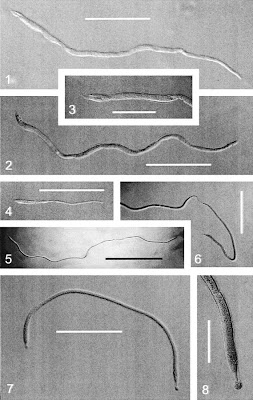
Mystery Micrograph #21

Johan got the last one -- it was Colacium, a euglenid of all things! Ok, for this one, you might not get to the genus, but the more you narrow it down, the better. Sorry, 'eukaryote' doesn't count. Warning: It's evil.

Scalebars: 1,2,4,7 - 250um; 3,6,8 - 100um; 5 - 500um. To be referenced later.

Edit 10.05.10 - Hint: The following is a relatively close relative. This one is guessable to the genus level.

Scale = 100um. To be referenced later.

Sunday Protist -- Rostronympha and latest parabasalian taxonomy

Since I just spent hours staring at onychophorans (instead of studying), gonna skimp out on the Sunday Protist this week. So here's a wonderful alien-looking freak with a proboscis, Rostronympha; I totally demand an SEM of this, by the way:

Parabasalid Rostronympha. Image by Guy Brugerolle via Micro*scope.

I can't find the original description at the moment, but vaguely recall having searched for it ambitiously once and failed miserably. It's supposed to be (Duboscq, Grassé & Rose, 1937), with a later mention in PP Grasse, A Hollande (1963) Ann. Sci. Natur. Zool. Ser "Les flagelles des genres Holomastigotoides et. Rostronympha". Might as well order it sometime...

And now onto a really nice taxonomic summary of parabsalians by Cepicka, Hampl and Kulda 2009 in Protist:

Recently revised parabasalian taxonomy.

There are now six classes: Trichomonadea, Hypotrichomonadea, Cristamonadea, Tritrichomonadea, Spirotrichonymphea and Trichonymphea. This will be on the final AND your next weekly spelling test. More importantly, this is how they relate:

Phylogenetic relationships between the six new classes.

Ok, I must run...will definitely get back to parabasalians in much more detail later. Some people in our department happen to be rather obsessed with them, and obsession can be contagious. But for now, feel free to join me in salivating over that really sweet diagram!

Right, finals...

Source:
Cepicka, I., Hampl, V., & Kulda, J. (2010). Critical Taxonomic Revision of Parabasalids with Description of one new Genus and three new Species Protist DOI: 10.1016/j.protis.2009.11.005

Social onychophorans!

ResearchBlogging.orgAs much as I'm obsessed with protists, I'm a rather promiscuous type when it comes to academic relationships, and thus can find the occasional non-protist cute and interesting. Forgive me if that is 'immoral', but I'm not Christian and thus am not obligated to be intellectually monogamous. So there.

Onychophorans (velvet worms) are fucking adorable. Now, whether they are more or less adorable than, say, hypotrich ciliates or Apusomonas proboscidea, is open to debate (I remain loyal to my tribal academic affiliations in that regard), but there's no way you can look at this wonderful creature and not think it's damn cute:

Something about onychophoran morphology resonates quite nicely with our innate aesthetic senses...or maybe it's just me. Some of them have really pretty patterns too, or come in absolutely bizarre colours. (Mayer & Herzsch 2007 BMC Evol Biol)

A while back someone was waxing poetic about social spiders in class, which led me on quite an adventure. Since I had something very important to do that night, like an exam the following day or something, I got a lot of procrastination done: read about various social spiders (who also have an interesting story of evolutionary dead ends and conflicting levels of selection; oh, and a species with observed cooperative transport of large prey -- apparently fairly rare in arthropods), made my way to social pseudoscorpions (some of them apparently disperse by riding large insects like bugs or beetles), and then I hit upon this paper:
Social behaviour in an Australian velvet worm, Euperipatoides rowelli (Onychophora: Peripatopsidae) (Reinhard & Rowell 2005 J Zool)
Social behaviour in onychophorans? Seriously!? On a second thought, why the hell not? And then came a complete overload of cute that could've only been enhanced by better images...velvet worms who cuddle!

As cuddly as they may seem, these guys also have a strict social hierarchy involving an alpha female. Reinhard and Rowell (2005) describe a feeding process where a cricket was thrown into the petri dish and attacked by the adult onychophorans (who trap their prey with sticky salivary secretions). After subduing the cricket, the first female fed on the prey for nearly an hour, biting and chasing off any other individual that would approach. After that hour, other females were allowed to feed, and then eventually males and juveniles. Most of the males were feeding after the females left. A feminist's paradise.

The interactions between individuals were observed and classified into dominant vs. subordinate: biting and chasing were done by the dominant individual (with the subordinate fleeing) whereas climbing was done by the subordinate and up to the decision of the dominant whether or not to be tolerated:

Juveniles were generally left alone and tolerated. Meanwhile, the adults were involved in a constant display of aggression and submission. Females were dominant to the males. When groups of onychophorans from different logs (thus, different social groups) were pairs, individuals of both groups acted aggressively to each other, and despite the males insisting on climbing, no aggregations were formed as they were ruthlessly rejected. Thus, the social groups are stable and at least these onychophorans seem to be capable of kin recognition.

The dominance hierarchy seemed largely size-dependent, with smaller females almost always being subservient to the larger individuals. It is believed that as in many other instances of sociality, social behaviour here aids in the cooperative capture of large prey. Curiously, the strict hierarchy when it comes to feeding, with the alpha female hoarding the entire prey, is not known in any other invertebrate.

Onychophoran behaviour doesn't receive much attention, perhaps at least partly due to the onychophoran's idea of a perfect habitat not coinciding all too well with that of an ethologist: velvet worms love cold, damp places. So it wouldn't be too surprising if an entire group of social species were eventually discovered, perhaps even with separate origins. In fact, Reinhard and Rowell (2005) state that it is not even known whether sociality may be common for onychophorans in general. On the topic of behaviour, despite their cute and almost fluffy appearance, onychophorans can also be quite vicious. This one devoured a spider bigger than itself:

Sticky spit vs. sticky silk. Quite surprisingly, the spit won this battle. (while checking whether this spider actually produces silk, found out that apprently tarantulas secrete adhesive silk from their feet...)

It is thought that in order to partake in such complex social behaviours, the onychophoran must have a fairly well-developed region for higher level sensory processing. (considering the complexity of the visual and olfactory cues likely involved in this case, it seems quite plausible. That said, there may well be fairly intricate social interactions out there that do not rely on complex neurology, by executing much simpler rules...) Curiously, they seem to have structures similar to 'mushroom bodies' in arthropods responsible for visual and olfactory processing and regulating complex behaviours. Actually, that was just an excuse to show this stunning image:

Onychophoran nervous system. Pseudocoloured to reflect the nerve depth in the confocal projection. Parts of the nervous system arise in a segmented fashion (eg. leg innervation), parts are repeated but not in a segmented way, and they also lack segmental ganglia as those in arthropods. Thus, onychophorans are slightly segmented in some respects, if you will, but still quite different from annelids and arthropods. This image really needs to be submitted to Nikon Small World... (Mayer & Whitington 2009 Dev Biol)

Now I don't want to divert attention away from onychophora by mentioning their significance in understanding arthropod (and other Ecdysozoan) evolution -- one almost feels sorry for onychophorans as they're usually introduced as "that group that is interesting because it tells us stuff about those other lineages", and that really bugs me. But still, onychophorans are particularly important for evolutionary biology, especially since invert phylogeny seems to be in a bigger mess than that of protists**. It was typically thought that annelids and arthropods shared a common origin of segmentation, but some recent data conflict with that.

Onychophorans, conveniently branching between annelids and arthropods, seem to have little going on in the way of nervous segmentation. It has been first interpreted as having a reduced segmental nervous system with the ventral nerve cord bearing relics of reduced ganglia. The ring nerve bundles are absent in the leg regions (and present between them) in a segmentally-appearing fashion; however, Mayer & Whitington (2009) have shown that the number of bundles between each leg pair varies and that unlike in arthropods, ventral organs do not coordinate neural development, as they develop fairly late relative to the nervous system. Curiously, the function of ventral organs in onychophoran development seems to be poorly understood.

Thus, segmental ganglia seem to have evolved in annelids and arthropods separately, adding further support to the Ecdysozoa idea (a debate I know next to nothing about...). The story of protist phylogeny has shown that convergence is much more rampant than we'd like to think, so it would be quite interesting if the nervous system of annelids and arthropods is also a case of convergent evolution, further showing how outright dangerous it is to rely on morphology for phylogenetic reconstruction. Metazoan phylogeny is a mess. While trying to get a grip on invert phylogeny for a class, I found it rather daunting how much I'd have to learn in order to make any sort of personal judgement on the matter. While protists are enough to keep one busy and fascinated (and overwhelmed) for many lifetimes, it is still fun to occasionally wander outside one's field and check out the daunting questions others have to deal with.

Besides, prior to taking a course in developmental biology, I actually had quite an interest in it, before it was quelled mercilessly by having to memorise structures of the 72h chick embryo. Without any evolutionary context. I think studying unicellular development would be useful for those studying multicellular development, as there must surely be ultimate convergence between many processes and structures. After all, there's only so many ways one can establish polarity, regulate morphology, grow, reproduce, etc. Comparative study of the developmental biology of the various eukaryotic (and prokaryotic!) supergroups and phyla therein would surely be a fun field once enough is known about organisms that are NOT mice, mustard weed, baker's yeast and fruit flies.

Ummm, how did I go from protists to onychophoran developmental neurology again? Oh right, procrastinating with physchem final can do wonders to one's intellectual promiscuity (aka procrastination-induced curiosity...) But onychophorans are damn cute, aren't they?

Oh, and by the way, onychophorans are so totally like caterpillars. Especially the live birth part (in some species).

*OMG there are also eusocial thrips. With soldiers.
** I wonder if the traditional zoologists' repulsion towards anything molecular may be part of it...

References
Dias, S., & Lo-Man-Hung, N. (2009). First record of an onychophoran (Onychophora, Peripatidae) feeding on a theraphosid spider (Araneae, Theraphosidae) Journal of Arachnology, 37 (1), 116-117 DOI: 10.1636/ST08-20.1

Mayer, G., & Harzsch, S. (2007). Immunolocalization of serotonin in Onychophora argues against segmental ganglia being an ancestral feature of arthropods BMC Evolutionary Biology, 7 (1) DOI: 10.1186/1471-2148-7-118

Mayer, G., & Whitington, P. (2009). Neural development in Onychophora (velvet worms) suggests a step-wise evolution of segmentation in the nervous system of Panarthropoda Developmental Biology, 335 (1), 263-275 DOI: 10.1016/j.ydbio.2009.08.011

Reinhard, J., & Rowell, D. (2005). Social behaviour in an Australian velvet worm, Euperipatoides rowelli (Onychophora: Peripatopsidae) Journal of Zoology, 267 (01) DOI: 10.1017/S0952836905007090