Field of Science

Showing posts with label constructive neutral evolution. Show all posts

New paper on Constructive Neutral Evolution

Don't have time to blog this right now (off to protistology conference today -- will bring back lots of goodies!), but there's a new review paper about CNE out a couple weeks ago. It's paywalled at some rather obscure journal that an institution as big as UBC doesn't have access to, so here's a pdf y'all can [hopefully] access!

Lukes et al. 2011 IUBMB Life: How a Neutral Evolutionary Ratchet Can Build Cellular Complexity

See, if this was published in a proper (ie, open access) journal, I wouldn't have to do this. As taxpayers you all have the right to see this, outdated publishers be damned.

I'm taking off to ISoP in Seattle - I might attempt to live tweet parts of it (as @ocelloid), so do follow us on twitter using the #isop11 hashtag! And for those of you who are gonna be there... let's see if you can find me ;-) (spoiler alert: Psi is a pseudonym. Seriously! o.O)

Sticky proteins, complexity drama and selection's blind eye

*For your entertainment, rejected titles:
[Sticky proteins and complex relationships]
[(protein) Relationship drama: promiscuous proteins in small populations]
[Not all is good that sticks: non-adaptive complexity gain through compensatory protein adhesion]
[Man, I suck at titles]

NB: This post can be considered as part 2.5 of my In defense of constructive neutral evolution series; also recommended for some background are part 1, discussing selection, drift and Neutral Theory, and part 2, discussing Constructive Neutral Evolution; to answer a popular question, part 3 *will* materialise eventually once I get off my ass and write it.

ResearchBlogging.orgConstructive neutral evolution is one mechanism of complexity increase without any associated increase in fitness – or, in other words, non-adaptive complexity gain. Basically, a random interaction between two proteins can lead to a fixed dependency if this interaction compensates for a mutation that was otherwise lethal – termed 'pressuppression'. In this way, previously unnecessary dependencies accumulate to make a very bulky, bureaucratic system that essentially does the same thing. We've all seen it in our institutions, and evolution is about as efficient.

Now, one bottleneck in this model is waiting for proteins to actually interact. Proteins are quite sticky and non-specific by nature, but usually not too much as that can be quite deleterious. Piling up a bunch of proteins on each other has a non-negligible chance of interfering with their function, and one would expect for chance interactions to not be excessively promiscuous, although those who have done regulatory genetics and protein work are probably aware just how annoyingly non-specific some of the protein binding can get. Luckily, there is now a possibly mechanism boosting these chance interactions, and thus alleviating that particular bottleneck in the Constructive Neutral Evolution process, rapidly accelerating complexification and protein network obfuscation to the extent where the interaction map looks like a web; not a finely organised web of an orb-weaver but rather one of those clumpy webs that are a clusterfuck of stickiness and silk. Enter this week's Fernández and Lynch 2011 Nature paper, from here onwards referred to as "the paper".

Protein 'stickiness' can be enhanced by biochemical means. Proteins vary in stability, and themselves come in populations – generally, most are in the optimal conformation that is presumably functional, but some individuals are messed up. This happens well past the sequence and folding errors, and some perfectly 'normal' proteins can be in a suboptimal state at any given time. Clearly, this affects the overall efficiency of the protein – even if it's enzymatically awesome, the overall 'protein' as we biologists understand it (sans population aspect) would decline in efficiency if a large chunk of its population is in a misfolded state.

One aspect that pushes around the proportion of the protein in the 'right' conformation is how well it plays with water. It shouldn't be too surprising that hydrophobic regions induce instability. What was new to me, but perhaps old news to those who actually understood chemistry, is that the exposure of the polar(hydrophilic) protein backbone to water also has a destabilising effect – and not only that, but often more significant than that of exposed hydrophobic regions! This may seem counterintuitive – doesn't water like hydrophilic regions? And there lies our problem.

Water molecules are attracted to polar groups, and the amino acid backbone is quite polar. This means little water molecules wander in towards the backbone and form hydrogen bonds with it. The problem is twofold: first of all, the protein, like all molecules, likes to 'jiggle'. The more it can jiggle in its given conformation, the more favourable that conformation is thermodynamically since its satisfied by more states. Entropy, etc. (now we're *really* entering territory I know nothing about, since my phys chem experience is locked away by PTSD...). Hooking up this backbone with water molecules reduces its 'jiggle' room, and makes it less thermodynamically stable – making change to other conformations more probable, therefore possibly leading to more errors in the protein population.

Secondly, as detailed further in the paper, water likes to hang out with more of itself. Water molecules are happiest in foursomes, sharing four hydrogen bonds with their neighbours. When a creepy protein backbone emerges and lures an unsuspecting water molecule away into the protein's murky depths, the water molecule cannot form as many bonds with its fellows (or as many hydrogen bonds, period), and is really sad and lonely. Or, in proper terms, the system becomes less stable, since thermodynamics will favour an arrangement where these water molecules are all happily coordinated with each other, and not being molested in a corner by an amino acid polar group. In other words, exposing the polar backbone (Solvent-Accessible Backbone Hydrogen Bonds, SABHBs in the paper) to water induces what is called Protein-Water Interfacial Tension (PWIT).

One way this tension can be released and the backbone exposure ('coded for' by genes, by the way) can be compensated for is if a random other protein (or more of its own kind) are recruited to cover that exposed backbone. This would help stabilise the protein conformation, and allow this potentially deleterious drawback to be tolerated (and get fixed in the population). Ultimately, the second (and third, etc) protein can become exapted for something useful, although just an eventual dependency is good enough to make sure these proteins stick together permanently. The crazy web of interactions gets crazier.

Fernández & Lynch's fig1a suffices perfectly but I like making diagrams, so I made one anyway. See text.
(Disclaimer: I'm horrible at chemistry, this may all have been thoroughly wrong...read the paper.)

Now I'm about the last person to willingly blog about biochemistry, and this seems to have little only a distant relevance to evolution, particularly the non-adaptive kind that fascinates yours truly. It will make sense in a bit. Recall from a few seconds ago (hey, already difficult for some of us) that protein instability leads to reduced protein efficiency. This reduction is generally tolerated, however, until it's bad enough to have a higher chance of being removed. Recall from [what should be] introductory population genetics that selection acts probabilistically, with true slightly deleterious mutations have a lesser, but still significant, chance of fixation than strongly deleterious mutations, which selection has a higher chance of taking care of before drift quietly fixes it. (more detail in older post here) Since proteins are, quite unsurprisingly, also governed by fundamental principles of population genetics, drift becomes involved there too.

As populations get smaller, drift becomes a more dominant force relative to selection, and the window of 'effectively neutral' mutations – slightly beneficial and slightly deleterious, but unlikely to be dealt with by selection – increases. More mess is tolerated. This means more protein inefficiencies are allowed to fix in the population, those induced by backbone exposure among them. Since there are now more proteins that are no longer happy with themselves (or, rather, have an increased Protein-Water Interfacial Tension), they are more likely to stick together for biochemical stability. And here Constructive Neutral Evolution can come in too, allowing further deleterious mutations that are now presuppressed by the recruited proteins. In a way, this greases the presuppression process, rather than competing with it as this BBC news piece made Ford Doolittle appear to suggest.

Now, this is all great in theory, but is there any real data in support of this? For one thing, there is a clear increase of interactome (set of all interactions in an organism) complexity correlating with decrease in effective population size, suggesting a link between lax selection and accumulating complexity. Furthermore, the proteins in organisms of these smaller populations have more blistering backbone exposures to water. Supporting the relationship with population size further yet with the advantage of more phylogenetically independent events (but less interactome data), bacterial intracellular endosymbionts consistently exhibit higher protein backbone exposure (hydration) than their free-living counterparts. Selection appears to disfavour not only polar backbone exposure (also described as 'poorly wrapped proteins' in the paper), but once again, the rise of interaction complexity as a whole. (Fernández and Lynch 2011 Nature, in case you somehow managed to miss that)

Obviously I like this paper because it adds another mechanism to the arsenal of evolutionary processes happening independently of adaptation. But moreover, I don't think one can find too many examples of biochemistry mixed with population genetics. You hardly find cell and developmental biologists thinking about population genetics, and perhaps many biochemists have never even been exposed to such a subject. When fields that should never come that close together do, some really nice explosions of insight can occur (my sad attempt at chemical metaphors). We really need to talk to other more, and maybe even wander over to other departments from time to time. It's sometimes (often) frustrating to communicate with those strange ones from afar, but just like ethnic xenophobia, its interdisciplinary counterpart must also be overcome.

-----
Figure 2a annoyed me a little as it ignored phylogenetic relationships, which is a big no-no when comparing properties of taxa. The figure is technically fine, especially since there aren't any correlation analyses there, but it's hard to discount phylogenetic history as being the cause behind the correlation of the traits without actually the characters on a tree. Anyway, since I like playing with data and running statistical analyses on things, especially when I didn't actually have to go through the pain of obtaining the data myself, I mapped some characters (interactome complexity from fig2a) on a phylogeny:


Unfortunately, even the most basic statistical operations become an epic headache when trees are involved, and very quickly things become painfully complicated, for the human as well as the computer. Especially when you're handed a dataset of mixed categorical and continuous characters, as I learned the hard way last night. After fighting Mesquite for a good many hours, I finally had to resort to extracting the Ne*µ (effective pop size * mutation rate; roughly put, both lead to increased selection efficiency) estimates from Lynch & Conery 2003 – relying on an intersection of two datasets meant that our taxon sampling was quite sad by the end of this enterprise. Anyway, I ran a pairwise comparison test (Maddison 1999 J Theor Biol) on the data, which probably isn't the best thing ever, but I got something resembling significance: p = 0.019. Depending on how statistically noisy your field is, you may even deem this acceptable. In any case, not too bad given my crude (and somewhat clueless) analysis and limited taxon sampling:

Moral of the story: the inverse correlation between interactome complexity and effective population size is unlikely to be a mere artefact of shared phylogenetic history. In other words, Fernández & Lynch's hypothesis stands strong.

I mostly did this because I thought it'd take a couple hours max. If hours meant days, that wasn't too far off... but hey, I learned something!

Acknowledgments: thanks to Lucas Brouwers for helping me wade through the heavy biochemical stuff, and to Mike Lynch for explaining the key idea of the paper a while earlier. Otherwise I would've probably been too daunted to even read it, let alone blog about it...
Oh, and my Twitter people for random phylogenetics advice ;-)

Reference
Fernández, A., & Lynch, M. (2011). Non-adaptive origins of interactome complexity Nature DOI: 10.1038/nature09992

[will add some supplementary refs once I return to internet on Monday...]

Irremediable Complexity – Science piece

Just wanted to bring to your attention that a new Perspectives piece finally came out in Science this past week, nicely (and in a concise way) summarising Constructive Neutral Evolution – that is, the capacity of non-adaptive and neutral processes to drive a seemingly directed increase in complexity.


Since non-OA publishers are lame and don't let the unprivileged lower creatures to see their articles, I put up a (hopefully) freely accessible pdf here. Hope the link doesn't die. Read it, it's like my previous ramblings on the subject but more concise and accurate and written by people who know what they're talking about ;-) (I also blogged Ford Doolittle's talk here)

Enjoy!

And yes, part III of my CNE post is coming, as well as the post on Mike Lynch's seminar talk. Let's just say that writing for work does not leave much guilt-free writing juices left for blogging about complicated topics. I mean, if I have the mind and energy to read papers and write about them, I feel guilty not spending that on the work I'm actually paid to do... Should catch up soon enough though, and then the blog monsters shall be unleashed and there will be no respite from the flood of intense protistiness that shall follow, bwahaha!

*The Dal is strong in this list...

In defense of constructive neutral evolution - Part II

ResearchBlogging.orgContinued from Part I here

Part I
- Adaptationism vs. Neutralism
- "Population genetics ignores reality!"
- Existence of neutrality and near-neutrality
Part II
-Neutral evolution is relevant
-Evolution lacks foresight; it can neither anticipate nor respond
-Clarifying some terminology: two types of function, positive vs. negative selection
-Rise of complexity through non-adaptive means
-An example of constructive neutral evolution at work: loss of group I intron self-splicing
Part III
-Further examples of constructive neutral evolution
-Discussion of what sparked this argument: Evolution of ciliate nuclear dimorphism

Neutral evolution is relevant

Again, apologies for stating the obvious, but apparently even some prominent evolutionary biologists popularisers of evolutionary biology fail to grasp this simple concept. I've masticated this point to a fine mush by now, but selection and neutral processes act in tandem. Mutational bias and drift matter. So often in the literature you find people arguing over whether something is an adaptation or a spandrel. This gets even more absurd when the structure in question is as massive as the human language capacity. For example, in the landmark Pinker & Bloom 1990 paper signalling the revival of evolutionary linguistics, you find awful sentences like:
"The key point that blunts the Gould and Lewontin critique of adaptationism is that natural selection is the only scientific explanation of adaptive complexity." [p.6; emphasis mine]
First off, it's kind of cute that a couple psychologists seem to think they can so easily outright dismiss a point made by evolutionary biologists. I mean, seriously, I find it adorable. On that note, I'm now gonna write a book chapter debunking generative linguistics, because, well, my buddy says they're wrong. I wonder how much Pinker's evolutionary views have been shaped by Dawkins et al. Their camp is rather influential outside evolutionary biology, and while many claim that panadaptationism is a strawman -- and even in biology that point is debatable -- outside evolutionary biology, panadaptationism is alive and well. Part of the reason is that adaptationist stories are written in popular books, while pluralistic approaches largely remain hidden in the likes of Molecular Biology & Evolution, Biology Direct and Journal of Molecular Evolution. Researchers working in applied evolutionary fields have likely never heard of them.

Back to Pinker & Bloom, first off it's quite a tautology to claim that adaptive complexity evolves through adaptation. Well, yes, you JUST labelled it adaptive. In the immortal words of 4chan, long cat is loooooong. Casting that aside, they've falled for a false dichotomy. You would think someone as smart as Steven Pinker and Paul Bloom wouldn't fall for it. But they did. Why does it have to be one or the other? Why adaptation or spandrel? Especially when we speak of highly complex systems -- is it not in the definition of complexity that they consist of multiple components? How likely is it that all of them are adaptive or neutral or maladaptive? Is it even remotely productive to reduce a system so drastically as to label it simply as an adaptation? What does that even mean, besides stating the obvious? 'Adaptation' has got to be one of the more utterly useless terms in evolution biology, at least the way it's abused today.

Letting Pinker & Bloom speak further:
"Adaptive complexity" describes any system composed of many interacting parts where the details of the parts' structure and arrangement suggest design to fulfill some function. The vertebrate eye is the classic example. The eye has a transparent refracting outer cover, a variable-focus lens, a light-sensitive layer of neural tissue lying at the focal plane of the lens, a diaphragm whose diameter changes with illumination level, muscles that move it in precise conjunction and convergence with those of the other eye, and elaborate neural circuits that respond to patterns defining edges, colors, motion, and stereoscopic disparity. It is impossible to make sense of the structure of the eye without noting that it appears as if it was designed for the purpose of seeing -- if for no other reason that the man-made tool for image formation, the camera, displays an uncanny resemblance to the eye. Before Darwin, theologians, notably William Paley, pointed to its exquisite design as evidence for the existence of a divine designer. Darwin showed how such "organs of extreme perfection and complication" could arise from the purely physical process of natural selection." [p.6 cont'd]
Holy fucking crap, argument from design, for selectionism! Impressive. Yes, you guys just totally pwned Gould with the vertebrate eye. He was unaware of its very existence. Eyes don't preserve well in the fossil record, you see? Eyes look designed, therefore selection. Great. I'll let them finish...
"The essential point is that no physical process other than natural selection can explain the evolution of an organ like the eye." [p.6]
AFAIK, Gould never denied selection!!! He was a brilliant biologist who thoroughly understood evolution, unlike some recent drama queens. What Gould argues is that a) not everything is an adaptation and b) adaptation is neither the sole nor the most important 'force' in evolution (nor is it actually a 'force' of any sort...). Furthermore, while I am unaware of Gould's opinions about The Eye, and am currently too lazy to research the topic, to me it seems highly implausible that the vertebrate eye evolved solely through selection. In fact, considering that selection is a purifying, not driving, 'force' -- that is, selection simply removes the not sufficiently fit -- it is curious to see where Pinker & Bloom think the 'material' for the selective evolution of the eyes comes from. Surely they're not insane enough to believe that the thing evolved entirely through point mutations each making the eye progressively slightly better and better and suddenly, veeeery gradually, ta-da: The Eye!

On that note, I wonder if there's a strong link between selectionism and gradualism. In a sense, one does kind of have to believe the above point-by-point scenario to explain how anything arises purely by selection. To anyone with the slightest inkling of how genes and genomes work, such a view is obviously absurd. Although considering how Dawkins has already enlightened us that molecular biologists may or may not be -reputable- biologists...

I'm still amused by how remarkably cute it is of Pinker & Bloom to know so much about the details of evolution that they can make bold statements like the last sentence cited above. That's one strong statement!

tl;dr Some rather reputable and smart people still fall for the false dichotomy where something is either purely adaptive or purely 'random'. Selection is not the sole source of order (Lynch 2007 PNAS; you might as well head over and read that paper by now)

So if selection is not the only source of order, what else could be? How can neutral forces (coupled with negative selection) result in an increased complexity? Ah, nearly time for constructive neutral evolution. But prior to that, one more thing to take care of...

Evolution lacks foresight; evolution is not engineering
First of all, one must note that a modern function of any given system may not necessarily have been there at the initial stages of evolution. In fact, it is often counterproductive to even assume so. A nice example would be diatom sex.

Upon each division, one of the diatoms gets smaller. The cell is surrounded by two valves: a larger top valve and a smaller bottom one. During division, the bottom one actually becomes the top in the daughter cell. After several generations, some diatom offspring get a little on the small side. Luckily, sex makes them bigger; ie. they produce gametes (or swap nuclei), fuse and make a brand new maximum-sized cell. Jennifer Frazer wrote an awesome post on this topic.

One may look at diatoms and say: What is the function of sex? If you remove sex, the diatoms can't get bigger again, and die a miniscule death. Thus, sex must be there to get bigger!

However, one must imagine evolution as a blind step-by-step process, devoid of any foresight or momentum whatsoever. A common fallacy would be to think of the diatoms first having a problem, and then having to come up with an emergency solution to it, eg. evolve sex. This may seem obviously ridiculous in the case of something as complex as sex, but is often assumed for simpler cases, like evolving a resistance to something. Perhaps we get this picture from the antibiotic resistance examples in bacteria; however, antibiotic resistance is generally much too simple, and bacteria much too numerous, to apply this mode of evolution to everything else. It is additionally pretty rare, but we don't notice the vastly overwhelming multitude of unsuccessfulcases.

Back to our diatoms, the more plausible scenario is actually that sex was there first, and was able to correct for the problems caused by this rather suboptimal mode of mitosis. Sex enabled this peculiar life style; it did not evolve in response to it. 'Enable' is a word that must be used much more frequently in the literature. Certain situations enable certain mutations or other changes to persist or excalate into fixation (either by drift or selection). They do not actually push them there.

Again, evolution cannot anticipate.

Two meanings of 'function'
As a brief aside, it is important to note two distinct meanings of the term 'function', often used rather carelessly:
1. Selected function - what a certain trait would have been selected for in its evolutionary past.
2. Current function - based upon what would happen were the trait removed in the present.

Going back to our diatom example above, the current function of sex in diatoms can be argued as a way to increase the population size back to original levels; for inhibiting sex would remove a way for the organisms to get bigger again. However, this is not the selected function of sex, since it must have already existed before the size problem happened. (the selected function of sex, if any, remains a fuzzy, murky mess)

Positive vs. negative selection
One more brief thing to clean up: 'types' of selection
Negative (aka purifying) selection - selection acting against a trait
Positive selection - selection promoting a trait in a population, usually through competition (the type most commonly spoken of in popular media, despite being far less common to the point of relative rarity...)

Ultimately, positive selection is a form of negative selection where the appearance of a fitter form of a trait renders the rest of the variants relatively less fit, resulting in them being selected against (negative selection). Thus, selection isn't actually ever for anything, strictly speaking. Selection is a constraint, weeding out variants that are insufficiently fit. Furthermore, selection is always lurking about in background, albeit in varying intensities depending on the conditions (see Part I). That said, one must not ever conflate selection with adaptation -- they are not the same thing by any means!

Rise of complexity through non-adaptive means
I won't go into much detail here as I'm sure Arlin Stoltzfus himself will explain it much better in his upcoming posts on Sandwalk. Also, unlike me, he's actually qualified to write about this stuff. I will give a crude overview (to the best of my understanding) along with a few concrete examples. For an additional source on this, I blogged Ford Doolittle's seminar talk on the subject here. The non-adaptive evolution of complexity requires tinkering, relaxed selection (eg. due to smaller effective population size) and ratchets. Tinkering is basic (as mentioned above, evolution lacks foresight, many adaptations are far from optimal as relics of past functions are retained, etc) so I won't discuss it. Small population sizes were discussed in Part I, so now we need the final piece: Ratchets. This is where Constructive Neutral Evolution enters.

In a nutshell, chance interactions may happen to compensate for otherwise-deleterious mutations, thereby enabling them to eventually occur, thereby ultimately resulting in an irreversible dependency upon the interaction. That way, complexity (loosely defined as number of components and interactions within a specified system; as in Lukes et al 2009 PNAS) can increase without ever actually being adaptive. This mechanism stresses that not all complexity is actually 'better', and perhaps much of it may well be a case of mere bloating, much like the bureaucracy of an institution with time. For a system that is required to be constitutively functional, it is in fact easier to bloat complexity than to trim it down, partly just due to basic combinatorics: there are many more ways of being complicated than being simple, and just statistically there'd be more viable states of higher complexity.

Overview of Constructive Neutral Evolution. Modified and enhanced from older diagram here; Ford Doolittle uses something similar in his talk, so it shouldn't be too far off.

This model, while being employed more in molecular biology, is actually applicable universally. Ratchets occur in ecology (someone brought up ecological specialisation as an example), sociology (your favourite institutional bureaucracy), and even evolutionary linguistics (eg. many types of change are irreversable or unlikely to be reversed). Going back to our non-anticipatory step-by-step evolutionary thinking: constructive neutral evolution is powerful. It provides the 'push' where adaptation cannot explain a particular increase in complexity. Ratchets provide an appearance of directionality to a system.

Cyt-18 and the N.crassa mitochondrial self-splicing intron
I will discuss the not-so-self-splicing intron examples in further detail in part III, but just to provide a quite example to the above point, let's look at a Neurospora mitochondrial self-splicing intron that developed a dependency on another protein. This example is based on an old-ish paper, Akins & Lambowitz 1987 Cell. It was found that mutants of cyt-18 exhibited defects in the splicing of group I (self-splicing) introns. Curiously, cyt-18 turned out to be homologous to tRNA synthetases. Further work confirmed that cyt-18 is necessary for splicing in N.crassa, and phylogenies showed it to be a derived trait. That is, in closely related lineages, cyt-18 is NOT necessary for group I intron splicing.

Now the question is, why would N.crassa require an additional protein to perform the same process its relatives can do without involving extra bits. The knee-jerk adaptationist reaction would be to think of it as being somehow better that the simple fully-self-splicing variant. Perhaps the use of a protein enables a better regulation of splicing. For some reason, any peculiar complexity in genetics has to be there for regulation. Apparently, evolution is directionless but still strives for higher complexity of regulatory systems, if you listen to molecular geneticists. However, is this necessarily true for all instances of higher complexity of interactions? How else could complex interactions arise if not for the improvement of a system?

This is where our friendly neighbourhood ratchet, constructive neutral evolution, comes in. Suppose initially the group I intron spliced itself out without the help of any proteins. Just incidentally, a random protein, in this case cyt-18, just happened to bind to it at times. Anyone who's worked with yeast-two-hybrid systems or done immunoprecipitation would be painfully aware of 'false' interactions; that is, when proteins interact biochemically but without any biological significance; or very rarely bind in vivo to begin with. The network of such fortuitous interactions is vast, and increases rapidly as more components are involved -- a positive feedback loop.

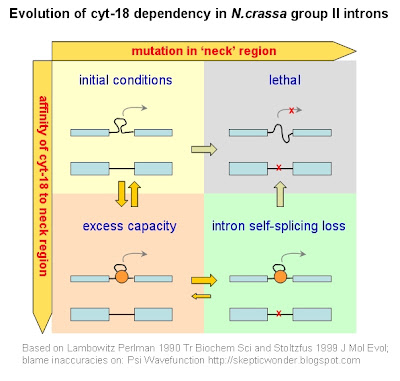
In the Akins & Lambowitz example, the self-splicing intron needs to form a particular secondary RNA structure to remove itself. For the sake of simplicity, let's pretend it has a single neck leading to a loop. The neck needs to form properly in order for the splicing to work, so any mutation destabilising the neck would be lethal. This means these mutations are 'impossible' in the evolutionary sense, as we're unlikely to ever see them.

Now let's say this cyt-18 protein happens to bind to the neck region, and stabilise it slightly. In the grand scheme of things, the intron can splice out properly regardless of whether this protein is there, so it doesn't increase fitness in any way. However, what this protein does to is create an excess capacity in the system by enabling certain otherwise-deleterious mutations to arise in the neck region by compensating their destabilisation effects. Once such a mutation occurs (and it's bound to happen eventually), the lineage now depends upon cyt-18 for proper splicing to occur. Since the chance of the mutation being reverse is quite small, and often even less than the chance of another otherwise-deleterious mutation further fixing the protein dependency, the system is now stuck depending on cyt-18, with no adaptive advantage whatsoever. In a diagram:

N.crassa mitochondrial self-splicing intron example of constructive neutral evolution. See text. Based on Akins & Lambowitz 1987 Cell, Lambowitz & Perlman 1990 Tr Biochem Sci, Stoltzfus 1999 J Mol Evol.

In such a manner, interactions can rapidly accumulate and form the ridiculously intricate pathways that horrify biochemists, geneticists and cell biologists alike, not to mention anyone working with 'transcriptomes' and 'proteomes' and (ewww) 'interactomes'. Not all of these complex pathways are that way for adaptive reasons, despite the common assumption. Some of these complexities can later be exapted for adaptive reasons, sure, but arguably most didn't initially arise adaptively. See Lynch 2007 Nat Rev Genet for a review on neutral evolution of gene interaction pathways.

My hunch at the moment, which may or may not have anything to do with reality, is that most complexity initially may arise through constructive neutral evolution, and some of it later drifts into doing something useful, upon which the lineage fixes a dependency, occasionally through 'positive' selection. Neutral explanations for complexity alleviate the need for awkward scenarios where an organism desperately needs to evolve something quickly as a response. The chance that the right features evolve at the right time, and not before the whole lineage dies off, is usually not very high. But when a lineage has been 'preadapted' through such neutral means, it wouldn't be as adversely affected by changes, or by finding a new niche, or whatever. Evolutionary adaptation is not a particularly efficient response mechanism, but neutral evolution is a wonderful source of 'enabling' modifications (excess capacities) that can later be molded into apparently functional parts. The explosion of complexity is controlled by negative selection, preventing it from getting too extreme and costly, although in organisms with smaller effective population sizes (where drift often overpowers selection; see Part I), complexity can get quite extreme nonetheless.

Most supporters of neutral theories and pluralism perhaps wouldn't be as extreme though, so don't take the above paragraph too seriously. In Part III, I will discuss further examples, including the little that is known about the evolution of ciliate nuclear dimorphism as well as gene scrambling, which was the original topic that sparked this discussion. Furthermore, I'd like to try and extrapolate this model beyond molecular biology, venturing a bit into evolutionary linguistics, which may also be teeming with ratchets. Hopefully by now you'd see that the concept of neutral evolution being capable of driving complexity is at the very least worth considering.

As Michael Lynch pointed out (eg. 2007 PNAS), selection may very well not be the sole source of order and complexity. In some cases, perhaps not even the dominant one.

References
Akins, R., & Lambowitz, A. (1987). A protein required for splicing group I introns in Neurospora mitochondria is mitochondrial tyrosyl-tRNA synthetase or a derivative thereof Cell, 50 (3), 331-345 DOI: 10.1016/0092-8674(87)90488-0

LAMBOWITZ, A., & PERLMAN, P. (1990). Involvement of aminoacyl-tRNA synthetases and other proteins in group I and group II intron splicing Trends in Biochemical Sciences, 15 (11), 440-444 DOI: 10.1016/0968-0004(90)90283-H

Lukes J, Leander BS, & Keeling PJ (2009). Cascades of convergent evolution: the corresponding evolutionary histories of euglenozoans and dinoflagellates. Proceedings of the National Academy of Sciences of the United States of America, 106 Suppl 1, 9963-70 PMID: 19528647

Lynch, M. (2007). Colloquium Papers: The frailty of adaptive hypotheses for the origins of organismal complexity Proceedings of the National Academy of Sciences, 104 (suppl_1), 8597-8604 DOI: 10.1073/pnas.0702207104

Lynch, M. (2007). The evolution of genetic networks by non-adaptive processes Nature Reviews Genetics, 8 (10), 803-813 DOI: 10.1038/nrg2192

Pinker S, & Bloom P (1990). Natural language and natural selection Behavioral and brain sciences, 13 (4), 707-784

Stoltzfus, A. (1999). On the Possibility of Constructive Neutral Evolution Journal of Molecular Evolution, 49 (2), 169-181 DOI: 10.1007/PL00006540

Irremediable Complexity: Notes from Ford Doolittle's seminar talk

While I work on polishing up Part II of the Neutral Evolution series, thought I'd write up and post my four pages of notes from Ford Doolittle's seminar talk today yesterday, while I can still remember what my scribbles were supposed to mean. As there's no unpublished data there, and a long-awaited paper on the subject has just been submitted, I believe it should be fair game for blogging. Coming from a vicious field (Arabidopsis, sigh...), I'm generally rather cautious about blogging department talks and such, but Constructive Neutral Evolution is a subject in need to spreading, and not a particularly competitive area at the moment...

Rosie has another summary of today's yesterday's talk, with an executive summary therein; she tried to scoop me, so clearly this means I must outdo her in length and verbosity =P

[If anything doesn't make sense, it's very likely an error on my part]
-----
Irremediable Complexity - Ford Doolittle, 07 Apr 2010
[paraphrased from notes; own comments in grey]
- Is each step in the evolution of a complex machine useful?

Irremediable complexity involves three factors: Tinkering, small populations, ratchets (Constructive Neutral Evolution). [prior to that, must discuss common views on complexity first]

Common views on complexity
- Directionality: 19th century - divine forces guide evolution; 20th century - orthogenesis - evolution exhibits a drive towards perfection (and complexity)
- Progress: Life started off being simple and became increasingly complex
But is there necessarily a trend?
(Gould 1996 Full House) The Drunkard's Walk: if one starts off at a limit that cannot be passed, random steps will eventually lead away from this limit. Presumably, life began more or less at the lower limit of complexity (specialised parasites aside), so it's bound to get more complex as it's the only way to go.
In fact, complexity is increased only in a few lineages, which also happen to be the ones we really like to look at.

So is the evolution of multicellular animals and plants from choanoflagellate-like and chlamydomonas-like organisms, respectively, a drunkard's walk or driven by something (eg. selection)?

Selectionist explanations
- Accumulation of specific adaptations results in complexity (eg. The Eye)
Another example: larger genome size is an adaptation for more gene regulation which is required in more complex organisms. [Note: C-value paradox, etc] Molecular biologists have an obsession with 'mystery DNA' having regulatory roles...
- Arms races, sexual selection
Greater biodiversity/more competition between organisms stimulates greater complexity, eg through niche specialisation and sex selection
- Evolving evolvability
Outdoing one's environmental changes by evolving faster. Eg. Exon shuffling as a function of introns: introns space out exons allowing more novel combinations of these exons to occur, which may be adaptive.
Caveat with evolvability -- it's a clade-selection level trait, not individual level.

Neutral forces - should be our null hypotheses
- Tinkering (François Jacob) -- will still have traces of an apparatus' past functions along with new ones --> life is full of Rube Goldberg machines.
- Small population size -- mildly deleterious traits more likely to be fixed in smaller populations (Michael Lynch; more info in Part I of my Neutral Evolution series) Eukaryotes are a case of smaller population size relative to prokaryotes.
- Ratchets -- 1. Maynard-Smith & Szathmary's Major Transitions; 2. Stoltzfus & Covello's Constructive Neutral Evolution
Major Transitions: There are steps in evolution that are difficult or impossible to reverse -- act as ratchets.

Constructive Neutral Evolution: a previously fortuitous (non-functional) interaction can enable an otherwise-deleterious mutation to occur, resulting in a dependency upon this interaction. [a diagram is in the making]
More interactions evoke more opportunity for Constructive Neutral Evolution to drive (via ratchetting) an increase in complexity. [thus, the result would be an explosion of complexity past a certain threshold]
The dependency can be built up by other mutations, thus further solidifying the requirement for a given interaction.
Note that no positive selection is required at any step [only purifying], would also be more drastic in smaller populations where more deleterious mutations are fixed by drift. That said, positive selection can still play a role in parallel.

Examples:
Lambowitz's maturase-requiring group I self-splicing intron. [will be discussed in further detail in impending post] A derived Neurospora lineage requires a maturase for the splicing of group I introns whereas nearby relatives do not. Lambowitz later (2006) argues that maturase-mediated splicing evolved in response to the splicing problem, as opposed to enabling it to arise. This is putting the cart before the horse.

kDNA editosome (Trypanosomes et al.)
[Can be summed up in one interjection: whyyyyyyyyyyyyy???]
In summary, genes coded by the mitochondrial genome are non-sensical, and right after transcription the pre-mRNAs are edited by the complicated process involving templates and inserting various U's where they are needed.

There are several explanations that have been proposed:
- relic of the RNA world -- for starters, tryps are derived.
- to correct pre-existing mutations -- backwards logic again (cart before the horse)
- regulation
[Digression to discuss the two oft-conflated meanings of function]
1. Selected function -- how a trait got to be there
2. Current function -- what happens if trait is removed

Example from Maynard-Smith: Stiff back of the horse. Removal thereof would prevent humans from riding it, but no one can argue that the horse's back evolved so that humans could ride it in the future!

How editing really arose -- CNE [see Stoltzfus 1999 JME and Lukes et al 2009 PNAS(and subsequent correspondence)]: once the process started, it couldn't be reversed, thus complexity reached an absurd level.
"Absurdly complex spliceosome"
- if you think about it, it's "incredibly stupid" to have such a complex machine for removing introns
- cites "Five Easy Pieces" Sharp 1991 Science laying out a hypothesis for the evolution of group II introns
- see Lambowitz example for how the spliceosome may have arisen through initially-neutral protein interactions

Ribosome
Also by CNE. Roughly put, the RNA does most of the enzymatic work in the ribosome, with the proteins taking on more of a structural function. Presumably, initially the ribosome could've been entirely a ribozyme, picking up various proteins for supporting structural roles, like the Lambowitz intron, with the help of constructive neutral evolution.

Cited TW O'Brien 2003 IUBMB Life paper: the mammalian mitochondrial ribosome is smaller than that of its host (eukaryotic) yet larger than the prokaryotic counterpart; furthermore, many of the extra mitochondrial ribosomal proteins do not come from the eukaryote! This is a great example of convergence between the two separate evolutionary paths, both starting off with the small (at least in terms of protein count) prokaryotic ribosome and becoming bloated in complexity. Furthermore, mitochondria also have a greatly reduced effective population size, thereby encouraging the accumulation of complexity, unlike in their free-living bacterial brethren. [would be interesting to compare plastid, mitochondrial and eukaryotic ribosomal evolution, controlling for LGT, replacement, loss, and all the other crap associated with endosymbiosis, of course. A nice system with at least two independent replicates originating from very distantly-related sources]

[Another guy (unsure about citing personal communications without their knowledge) rather eloquently put it along the lines of "The rRNA was fully functional enzymatically on its own until the other shit stuck along for the ride"]


In closing, tinkering leads to klunkiness, smaller populations allow more mildly deleterious mutations, and ratchets make complexity ultimately unavoidable.

For another example of irremediable complexity, think what would happen if an institution was formed with a few small committees with specific functions and left alone for a few decades. Like a university. The bureaucracy and administrative complexity would increase while the overall efficiency of the system wouldn't benefit much. One can think of the complex biochemical pathways as "cellular bureaucracy".

"Complexity is unavoidable and largely irremediable: Resistance is useless"


-----
My initial impression of Ford Doolittle came from the whole 'missing Tree of Life' debacle, where he did appear rather rash and extremist, perhaps largely due to the media portrayal and associated uproar -- after his seminar talk and a more informal chat at lunch, I fully retract my first impressions, and must say that he's actually quite reasonable and not radical or extremist at all (and very pleasant and interesting to talk to). Naturally, science reporters reporters in general tend to hyperpolarise any slightest argument they chance upon, and turn anyone with a shred of an opinion into a flaming radical; thus it was another lesson to be extremely cautious about impressions you get about someone based on someone else's reporting. But another thing I've noticed is he seems less assertive in person than in his own papers as well. Well-balanced and subtle ideas seldom get the attention they deserve, so they must often be blown out of proportion to be at all noticed.

Perhaps this is another reason neutral theories remain so obscure: the adaptationists are occupied with explaining natural selection to creationists et al., thereby being much noisier and noticeable. The more balanced pluralists don't have much extremist thought to push, so they tend to get ignored (I find the Stoltzfus 1999 paper to be quite subtle and unassertive; perhaps that's why it was largely ignored).

Back to the ToL kerfuffle: If one were to say "LGT is very frequent in bacterial populations and may pose very substantial problems to reconstructing bacterial phylogeny and the deep history of life, perhaps even posing a valid question of whether such a phylogeny may truly ever be found", the statement is too reserved and subtle to make much of a splash beyond a small circle of specialists. However, if one goes all out and shouts "The Tree of Life is dead!", people actually turn around and look. Many misinterpret the message and get their own strange notions on the subject (often believed much more strongly than by the originator of the idea...), but at least some people get it and consider the problem.

Furthermore, the "Darwin was wrong" slant was intended to signal that we should get away from our Darwin fetish. I fully agree. Darwin was a great scientist, but it is outright immoral to ignore the hard work of thousands of people who came after him, and the thousands who are working in the field right now. Darwin may have sparked the field, but he is certainly not its most important element. The term "Darwinism" is vacuous and misleading, and should be abandoned soon. Furthermore, who cares what creationists think? Some of us are sick of having to change our vocabulary just because some religious idiot with an agenda could abuse it. The primary role of evolutionary biologists is to study evolutionary biology; educating the public is secondary (while still important); dealing with creationists is about last. Science educators are responsible for that. We cannot fight religion, especially its fundamentalist forms, with reason (hence why Dawkins fails at it). So what if they misunderstand and misrepresent Darwin? People misunderstand and misrepresent quantum mechanics even more, and yet physicists don't seem to lose sleep over it.

Political agendas will always be there; textbooks will always be influenced by the political (and sadly, religious) climate of the times. It sucks, but such is reality. History and the social sciences are also badly mangled in schools (eg. communism is still a topic not only taught entirely wrong, but also characterised by a blunt refusal to listen to those who may know better). After all, to understand science effectively, one must appreciate the subject, and be willing to not only accept, but commit work to it. The unwilling will never learn unless they want to. What is of a much higher importance than defending Darwin is promoting the overall public image of science and academia in general, and making academic activity 'cool' in the eyes of the public. If scientists were well-respected in 1970's Russia, there's no reason we can't acheive that again and in a different society. But it will take work.

But to get that to work, we must strive to suppress our polarising tendencies and recognise that often people's opinions are more subtle than they appear. We must also pay greater attention to ideas that are not pushed as aggressively as others, such as constructive neutral evolution. Those may well be more refined and ready for acceptance than the ideas cast in apparent simplicity and loudness.

References:
O'Brien, T. (2003). Properties of Human Mitochondrial Ribosomes IUBMB Life (International Union of Biochemistry and Molecular Biology: Life), 55 (9), 505-513 DOI: 10.1080/15216540310001626610

Sharp PA (1991). "Five easy pieces". Science (New York, N.Y.), 254 (5032) PMID: 1948046

Stoltzfus, A. (1999). On the Possibility of Constructive Neutral Evolution Journal of Molecular Evolution, 49 (2), 169-181 DOI: 10.1007/PL00006540

In defense of constructive neutral evolution - Part I

Caution: What follows is mostly an opinion piece by an undergrad. While said undergrad has done a fair amount of reading on the topic, the post is still subject to many errors. Tread carefully. [/disclaimer]

ResearchBlogging.orgI won't go into an all-out discussion of neutral evolution here: I'm neither qualified enough nor have enough spare time at the moment. However, some issues seem to crop up multiple times, both here and on other blogs. I figured I'd try to briefly adress some of them, although do take my discussion with a grain of salt. That said, while neutral theory require a certain amount of effort to grasp properly (just like any other aspect of evolutionary biology), it is not something worth dismissing. In fact, if you consider how horribly misunderstood evolutionary biology is on the whole (even among grad students: Gregory & Ellis 2008 BioScience), the neutral elements of evolution seem to be understood by a very small fraction of biologists even.

Perhaps part of the problem is that adaptive evolution is just...flashier. It makes for fun and fairly simple stories: Eg. the peacock has a huge tail to signal to the females that it has nice genes that would compensate for the problems it causes. This "Good Genes" theory is actually taught in first year curricula, and makes very little sense upon further examination, and definitely does not survive Occam's Razor. A simpler explanation would, of course, entail something like runaway sexual selection (ie. female happened to prefer flashy tail, males with flashier tails outcompete their dimmer counterparts, tail gets longer) or that the tail may have a more important function, like scaring away predators. In any case, the adaptive approach very often results in what is mostly a story-telling exercise, and one that is very difficult to deal with experimentally. Worst of all, those stories very easily make sense upon first glance, and thus the field becomes cluttered with poorly thought out theories that sound reasonable.

This post became way too long, so I broke it up into three parts; table of contents here:
Part I
-Adaptationism vs. Neutralism
-"Population genetics ignores reality!"
-Existence of neutrality and near-neutrality
Part II
-Neutral evolution is relevant
-Evolution lacks foresight; it can neither anticipate nor respond
-Rise of complexity through non-adaptive means
-Further examples of constructive neutral evolution
Part III
-Discussion of what sparked this argument: Evolution of ciliate nuclear dimorphism

Adaptationism vs. Neutralism
Of course, none of what I said is new by any margin: the famous Gould and Lewontin 1979 Spandrels of San Marco (free access) paper does a nice job at pointing out many of the fallbacks of panadaptationism. And I don't find it much of an 'attack', as it is often described by diehard adaptationists, but perhaps that's just me. Since so many before me have pointed out the fallbacks of the 'adaptationist programme', I won't bother dwelling on it any further. Besides, this type of thing causes a great polarising effect on the community, with people being either hardcore adaptationists or hardcore neutralists. This seriously fucks up any progress on the topic, because biology hardly tolerates dichotomies. In fact, the truth in this case does not even lie 'somewhere in the middle', but in the fact that both adaptive and neutral processes work in tandem.

Let me reiterate that: Selective and neutral mechanisms work in tandem. Simultaneously. In some situations (eg. large effective population sizes, in bacteria; Lynch 2007 PNAS, Yi 2005 Bioessays), adaptive processes are more dominant; in some cases, adaptive 'forces' are negligible compared to neutral phenomena (small effective population sizes). Considering some specific structure, parts of its evolutionary history have been driven more by drift and mutational bias, interspersed with parts dominated by selective pressures. It's not like selection takes a nap for a while, and then gets back to work while drift, bias et al. chill out. There is no point to dismiss one or the other, like so many tend to do.

Curiously, I've heard numerous times that "Well, maybe selection is less important for bacteria, but it is the dominant force in vertebrates". How hilarious is it that any population geneticist will tell you the exact opposite: bacteria are under overwhelming selective pressure due to their freaking massive effective pop sizes, meaning that drift is much less effective in that situation relative to selection. Vertebrates are actually an awesome example of selection going rather easy: being a large multicellular thing with a backbone is a damn stupid way to copy your genes. Seriously!

Now, you may wonder why should anyone who's not an evolutionary biologist care about any of this? For a cell or developmental biologist, why not assume everything is there for a reason?

Because this leads to rather convoluted explanations for things. Take signalling pathways, for example. Is there any particular reason you have tens of genes required to turn on a particular behaviour in the end when you could've 'designed' it instead to use only one or two? Here we have again a problem with the adaptationist approach: you can pretty much always think of some reason why something is 'useful' or adaptive. That doesn't make it right. What if some features of these pathways originally evolved as a form of adaptively-neutral 'bloating' of the system? See Lynch 2007 PNAS, Lynch 2007 Nature Rev Genet for more on non-adaptive processes in evolution of genetic pathways. (Or just stop reading this post and go through this short list instead ;-)).

"Population genetics ignores reality!"
Now, there's some complaints that popgen kind of fails at taking reality into account. For some work in the field, that is true -- just like in any other field. Did you seriously think everyone, to the last moron, is in touch with reality in your field? If so, I'd love to hear! (no philosophers need apply, heh... although to be fair, there are some 'fringe lunatics' there who actually make sense by our standards.) That said, mathematical modeling requires simplifications to be made to get somewhere. If you have a problem with that, note all those humanities scholars who are sneering at us because we make simplifications as scientists! They wisely take the easy way out and conclude that reality is a social construct and understanding is actually impossible and thus not worthy losing sleep over...

Good mathematical biologists note their simplifications, keep track of them, and know when to simplify what, and what the limitations of their models are. Even better mathematical biologists test their models empirically, thereby producing work that is truly relevant to the rest of us. In my [admittedly still quite inexperienced] opinion, Michael Lynch belongs to that category. Seriously, I despised and dismissed the entire field of population genetics as well, and thanks to some of his papers realised it's probably not a very good idea to do that. In a field as messy as biology, any tidbit of information, even if it comes from simulations, is not only valuable, but essential to the very hope of sorting stuff out. We, that is -- all biologists -- are in no position to discard entire fields because of our petty tribalistic snobbery. Tread with caution -- yes. Dismiss without a second thought -- absolutely not.

Existence of neutrality and near-neutrality
To touch on the existence of 'true' neutrality, let me show you a few diagrams. The first one outlines the history of selectionist and neutral theories:

Story of neutralism and selectionism. (Bernardi 2007 PNAS, OA) Similar diagram and accompanying story can also be found in Ohta 2002 PNAS

You can also see Tomoko Ohta's big review here: Ohta 1992 Annu Rev Ecol Syst (free access).

The major breakthrough here is not even so much the Neutral Theory (which was more of a wake-up call to the stagnating ultra-selectionists), but the Nearly Neutral Theory. Accepting near-neutrality enables one to deal with truly messy and ambiguous situations that don't fit so neatly into the advantageous-deleterious dichotomy. Furthermore, it allows a full spectrum, encorporating the fact that some deleterious mutations are worse than others, and vice versa for the advantageous ones. The 'strict-ness' of selection is further affected by additional factors, such as effective population size.

In short, selection acts probabilistically, not absolutely:

The probability of selection-dependent fixation of an allele vs. product of effective population size(Ne) and selection coefficient(s) of the allele. Note that holding s constant and increasing Ne shifts the selection-dependent fixation probability away from 1 (neutral). Thus, selection is probabilistic; there is also a time dependency here: the longer you run a given situation, the greater the chance that even the slightest deviation from neutrality will be acted on by selection. Given either infinite time or infinite population size, we would see a sharp cut off between advantageous and deleterious alleles. Neutrality would disappear. However, given that no biological system persists for infinite time or has an infinite population size, what one gets is a zone of effectively neutral (Nearly Neutral) mutations; again, the width of this 'zone' is inversely proportional to Ne Disclaimer: I am not well-versed in popgen by any means, please correct me where I'm wrong! (Yi 2006 BioEssays)

The further a mutation deviates in either direction from the true neutral (here assumed to be the same as previous state of the allele, in the context of mutations), the more likely selection is to do something about it, wither selecting against the allele in question, or selecting against those who lack the allele in question (aka "positive selection"). Crudely put, the larger the effective population size, the steeper the selection curve (ie slightly deleterious now becomes quite deleterious, etc).

This actually means that according to pop size alone, selection is far stricter in bacteria than it is in vertebrates. This makes sense: bacteria exhibit a lot less 'design stupidity', if you will, than we do. Again, creating a multicellular organism with a ridiculously long and expensive generation span and a pathetically low reproduction rate is about the stupidest way to perpetrate a handful of genes. But it is tolerated -- in large part because there is a niche for it beyond the reach of more efficient organisms, and to some extent because the effective population size there is so small as to allow the system to drift towards foolish complexity.

Want concrete examples? Genome complexity is a really nice one; I won't discuss details here, but see Yi 2006, Lynch 2007, Stoltzfus 1999, and more Lynch if interested.

To make take an analogy from ecology, a similar argument can be made for the existence of commensalism. Yes, strictly speaking, if you measure all effects and interactions to the finest detail, there are no commensal relationships -- even the slighest extra drag produced by free-riding fish on the manta ray (provided they don't do anything beneficial to it, too lazy to research) would be harmful thereby rendering the relationship parasitic. However, just as in the case of selection, there lies a fuzzy line between parasitism and mutualism, in many cases fuzzy enough to contain 'nearly-parasitic' and 'nearly-commensal' interactions. In that case, the relationship would not be harmful or beneficial enough to really matter within a finite (and turbulent) timeframe. Thus, it is probably more useful to use 'commensal' (well, nearly-commensal) than have to always scratch your head over whether the net total of a relationship is mutualistic or parasitic.

Now that we are hopefully at least considering the possibility of neutral mutations, why should anyone care? Aren't pure selectionists just a strawman anyway? Besides, aren't neutral mutations incapable of really doing anything useful or noticeable? And what the hell is constructive neutral evolution anyway? Stay tuned for this and more in Part II!

References and further reading:
Bernardi, G. (2007). The neoselectionist theory of genome evolution Proceedings of the National Academy of Sciences, 104 (20), 8385-8390 DOI: 10.1073/pnas.0701652104

Gregory, T., & Ellis, C. (2009). Conceptions of Evolution among Science Graduate Students BioScience, 59 (9), 792-799 DOI: 10.1525/bio.2009.59.9.11

Lynch, M. (2007). Colloquium Papers: The frailty of adaptive hypotheses for the origins of organismal complexity Proceedings of the National Academy of Sciences, 104 (suppl_1), 8597-8604 DOI: 10.1073/pnas.0702207104

Lynch, M. (2007). The evolution of genetic networks by non-adaptive processes Nature Reviews Genetics, 8 (10), 803-813 DOI: 10.1038/nrg2192

Ohta, T. (1992). The Nearly Neutral Theory of Molecular Evolution Annual Review of Ecology and Systematics, 23 (1), 263-286 DOI: 10.1146/annurev.ecolsys.23.1.263

Ohta, T. (2002). Inaugural Article: Near-neutrality in evolution of genes and gene regulation Proceedings of the National Academy of Sciences, 99 (25), 16134-16137 DOI: 10.1073/pnas.252626899

Stoltzfus A (1999). On the possibility of constructive neutral evolution. Journal of molecular evolution, 49 (2), 169-81 PMID: 10441669

Yi, S. (2006). Non-adaptive evolution of genome complexity BioEssays, 28 (10), 979-982 DOI: 10.1002/bies.20478